Cuba is Missing...From US Reports on the International Response to Haiti's Earthquake
By Dave Lindorff (about the author) Page 1 of 1 page(s)
opednews.com Permalink
For OpEdNews: Dave Lindorff - Writer
By Dave Lindorff
There are only two US media outlets that have reported on Cuba's response to the deadly 7.0 earthquake that hit Haiti. One was Fox News, which claimed, wrongly, that the Cubans were absent from the list of neighboring Caribbean countries providing aid. The other was theChristian Science Monitor(a respected news organization that recently shut down its print edition), which reported correctly that Cuba had dispatched 30 doctors to the stricken nation.
TheChristian Science Monitor, in a second article, quoted Laurence Korb, former assistant secretary of defense and now based at the Center for American Progress, as saying that the US, which is leading the relief efforts in Haiti, should "consider tapping the expertise of neighboring Cuba," which he noted, "has some of the best doctors in the world--we should see about flying them in."
As for the rest of the US media, they have simply ignored Cuba's role and actions.
In fact, left unmentioned is the reality that Cubaalready had over 400 doctorsposted to Haiti to help with the day-to-day health needs of this poorest nation in the Americas, and that those doctors were the first to respond to the disaster, setting up a hospital right next to the main hospital in Port-au-Prince which collapsed in the earthquake.
Far from "doing nothing" about the disaster as the right-wing propagandists at Fox-TV were claiming, Cuba has been one of the most effective and critical responders to the crisis, because it had set up a medical infrastructurebefore the quake, which was able to mobilize quickly and start treating the victims.
The American emergency response, predictably, has focussed primarily, at least in terms of personnel and money, on sending the hugely costly and inefficient US military--a fleet of aircraft and an aircraft carrier--a factor that should be considered when examining that $100 million figure the Obama administration claims is being allocated to emergency aid to Haiti. Considering that the cost of operating an aircraft carrier, including crew, is roughly $2 million a day, just sending a carrier to Port-au-Prince for two weeks accounts for a quarter of the announced American aid effort, and while many of the military personnel sent there will certainly be doing actual aid work, delivering supplies and guarding supplies, many, given America's long history of brutal military/colonial control of Haiti, will inevitably be spending their time ensuring continued survival and control of the parasitic pro-US political elite in Haiti.
Otherwise, the US has basically ignored the ongoing day-to-day human crisis in Haiti, while Cuba has been doing the yeoman work of providing basic health care.
But that's not a story that the American corporate media want to tell.
___________________
DAVE LINDORFF is a Philadelphia-area journalist. His latest book is "The Case for Impeachment" (St. Martin's Press, 2006). His work is available atwww.thiscantbehappening.net
www.thiscantbehappening.net
Dave Lindorff's writing is available at
www.thiscantbehappening.net. He is a columnist for Counterpunch, is author of several recent books ("This Can't Be Happening! Resisting the Disintegration of (
more...)
PLEASE READ TODAY'S REPORTEDLY ESPECIALLY REVOLTING ABUSES BY ISRAEL:
Human rights research: 197 Palestinians martyred in Israeli prisons
Middle East Monitor
 |
January 14, 2010
New research claims that 197 Palestinians have died in Israeli prisons since the start of the occupation of the West Bank and Gaza Strip in 1967. Human rights researcher Abdel Nasser Farwana claims that the figure includes women, children and the elderly. A former prisoner himself, Farwana said that his figures do not include those who died post-release due to the devastating effects of their detention. He numbers those cases in the "hundreds".
Farwana calls upon governments and human rights organizations to document the violations and crimes that were committed against these prisoners - these "martyrs" which were the key reasons for the deaths in custody and after release. "The authorities and monitoring bodies need to take concrete steps and bring to justice the criminals responsible for these deaths," said Mr. Farwana, who was particularly critical of the relevant Palestinian authorities whose knee-jerk reaction to deaths in Israeli custody rarely goes any further.
According to Farwana, 70 prisoners were martyred after being subjected to torture by the Israelis, 49 died as a result of medical negligence, 71 ex-prisoners were executed after their detention, and 7 prisoners died as a result of excessive force against them and from gunshot wounds. |
:: Article nr. 62160 sent on 14-jan-2010 18:47 ECT
www.uruknet.info?p=62160
Link: ow.ly/WuOq
The Extrajudicial Execution of Mahmoud Salah
Reham Alhelsi
 |
January 14, 2010
On 08.03.2002, 23 year old Mahmoud Salah from Nablus was killed in cold-blood by the Israeli border police. According to several witnesses, Mahmoud was arrested at the Beit Hanina checkpoint, searched and handcuffed. The Israeli police took off Mahmoud's clothes and 30 minutes after his arrest, and while under the control of the Israeli border police, Mahmoud was executed. A bomb-detecting robot was brought to deceive the world and claim Mahmoud was a suicide bomber. According to AFP, one witness, Yehiya al-Waari, 56, testified that Salah: "was assassinated half an hour after his arrest, after police completely subdued him."…"At around 4:15pm on Friday, a border guard police patrol came to the Third Project in Nuseibeh Housing Project in Occupied Jerusalem and summoned two youths who were in the street there, one of them was a member of the Nuseibeh Quarter and his name was Randy, and the other youth was saying that his name is Mahmoud from Nablus region"….."when Mahmud arrived, he was immediately handcuffed, then (the policemen) raised his hands and threw him against my car. Minutes later, a police bomb disposal unit arrived on the scene."… "A policeman had put his foot on (Salah's) neck, another was holding his legs while and a third his hands. All the neighbours and myself saw from our windows and balconies how he was executed, more than half an hour after his arrest," …"The members of the special units threw him to the ground and cut open and removed his clothes with a special blade, leaving him with only his boxer shorts on,"… "Members of the regular police were, from the start, clearly disagreeing with the members of the special units who executed Salah and were repeating in Hebrew: 'Let's kill him!". Al-Waari adds that the Israeli border police executed Salah "from a distance 40 to 60 centimetres … and left him lying on the ground for 40 minutes until his death. They then brought robot to remove an explosive belt".[1] Zionist and Co media repeated the propaganda of the Israeli border police claiming that the Israeli police had shot dead a Palestinian who was on his way to carry out a suicide attack. In one statement after the other, the Israeli police tried to justify the murder. One Israeli police spokesman, Kobi Zarhad, claimed that Salah "was wearing a explosive belt on his stomach and detonator on his chest." adding that "This person was killed because he could not be subdued. It is only after he was dead that we were able to remove the (explosive) belt".[2] In a press release, the Israeli police insolently claimed that Mahmoud: "was held on the ground, face down, while a bomb disposal expert attempted to dismantle the explosive device. This lasted a number of minutes. During this time, the suicide bomber attempted several times to detonate the bomb by rubbing his chest against the ground in the hope of activating the detonation switch. In order to prevent the murder of the policemen and the bomb disposal officer, the suicide bomber was shot and killed by police. The bomb was dismantled with the aid of a bomb disposal robot."[3] The Palestinians who witnessed the execution refuted the story of the Israeli border police, and said that it was an execution, a murder in cold blood. Unknown to the Israeli police, the whole execution was being filmed from a nearby building. The footage shows clearly how Mahmoud Salah was forced on the ground, his clothes being taken off (no explosive belt to be seen) and then executed. A robot is brought to "dismantle" the nonexistent explosive belt. The pictures taken prove what the eye witnesses said and expose the Israeli lies. -  Pic1: Israeli police arrest Mahmoud and his friend.  Pic2: Mahmoud pushed to the ground by the police.  Pic3: Witnesses are sent away through gun shots in the air.  Pic4: Witnesses are sent away through gun shots in the air.  Pic5: Mahmoud is being held to the ground. This refutes the Israeli lie that Mahmoud was killed because he could not be subdued.  Pic6: While pointing their guns at the handcuffed Mahmoud, the Israeli policemen take off his clothes.  Pic7: Mahmoud, handcuffed and almost naked, is executed. It's clear that there is NO belt, No large explosive device of any kind tied to his body.  Pic8: A robot is brought in to "examine the body". Mahmoud is dead on the ground face down. The pictures show Mahmoud's almost naked body. Nowhere is an explosive belt to be seen. Notice in Pic8, Mahmoud is dead on the ground face down, so how did the robot dismantle the – obviously nonexistent – explosive device? whatever it is the robot is "examining", it wasn't there as Mahmoud was executed. If that thing is the "source of the explosives", why was the almost-naked, hand-cuffed Mahmoud executed? Mahmoud was arrested, handcuffed, under the control of the soldiers and completely subdued for a whole 30 minutes before he was executed, which also refutes the Israeli lie that it took a few minutes. Pic6 shows some soldiers pinning Mahmoud to the ground just before executing him. If Mahmoud had an explosive device tied to his stomach, would the Israeli police hold him on the ground face down? Would they have held him and sat on him like that had they had 0.1% of a doubt that he had an explosive belt on him? No, they would never have dared do that. They were SURE there was no explosive belt! According to the Jerusalem Post, the Israeli Police Inspector General Shlomo Aharonishky called two Israeli border policemen who executed Mahmoud to personally thank them. Sources: www.ccmep.org/hotnews/images031202.html www.bintjbeil.com/A/news/2002/0311_salah.html
[1] http://www.ccmep.org/hotnews/images031202.html [2] Ibid [3] Ibid |
http://www.uruknet.de/?s1=1&p=62148&s2=15 ISRAELI CHARITIES 'CASHING IN' ON PALESTINIAN SUFFERING
Steve Amsel, Desertpeace
January 14, 2010

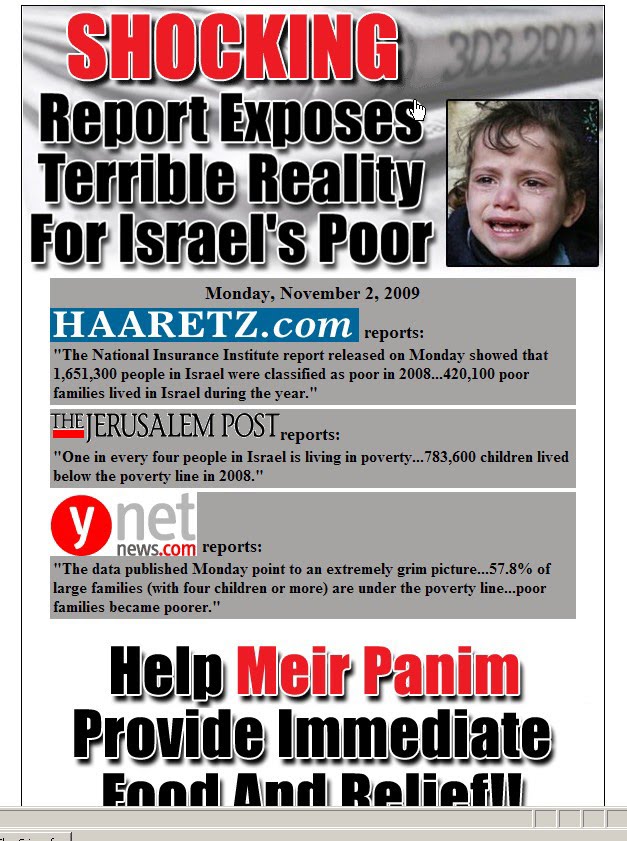
The above photo (part of an ad campaign) is being circulated throughout the Israeli press. The organisation that sponsored the ad operates (for hungry Jews only) soup kitchens in every major Israeli city. Below is the ad in question….
Feeding the poor is a wonderful deed…..asking for contributions to continue this work is to be expected….. BUT…. the photo used is not one of a poor, hungry Jewish child. It is the photo of a child in Gaza at the funeral of her brother who was killed by the zionists during the blitzkrieg a year ago. The same child can be seen in THIS article that appeared in the Telegraph.
The following montage shows the child in the ad and the (same) Palestinian child.  click on image to enlarge click on image to enlarge
How could the zionists be so deceptive? Along with their beliefs that Palestinians are not human, do they also believe that they feel no pain or suffering? Do they see nothing morally wrong with using images of suffering Palestinian children to raise funds for 'Jewish only' charities?
I have no problem supporting charitable institutions, especially those that feed the hungry, but I would NEVER support one that would turn away a non Jew, especially one such as Meir Panim. Just another example of the inhumanity of zionism and those associated with it.
|
:: Article nr. 62145 sent on 14-jan-2010 12:54 ECT
www.uruknet.info?p=62145
Link: desertpeace.wordpress.com/2010/01/14/israeli-charities-cashing-in-on-palestinian
-suffering/
1-15.1.10 – Demonstrators Met with Live Ammunition in Bil'in Village
http://www.bilin-ffj.org/index.php?option=com_content&task=view&id=240&Itemid=1 Today in Bil'in village demonstrators against the apartheid wall and illegal Israeli settlements were met with live ammunition, tear gas (in both plastic and aluminum canisters), rubber bullets, and sound bombs from the Israeli army. Rubber bullets and tear gas canisters injured six demonstrators. Many suffered from sever tear gas inhalation including Fatah leader Dr. Nabil Shath. Others injured include Palestinian cameraman Fadi Aljause and reporter Haron Amira, Bassem Ahmad Yassin (leg injury), Ibrahim Burnat (rubber bullet injury), Nayif Ghazi (tear gas canister head injury), and a man from Jericho who was taken to the hospital in Ramallah (we have not received information about his current condition).
Palestinian, Israeli and International demonstrators marched to the wall with a 10-meter-long Palestinian flag at which time the military immediately began firing tear gas into the crowd. The army entered the village and attempted to arrest two of the Palestinian activists. Israeli and International activists physically intervened in order to stop the arrests. Soldiers shot live ammunition into the air during the conflict in an attempt to scare and disperse the crowd. The crowd consisting of many Israeli solidarity activists did not disperse and began chanting "shame on you" in Hebrew. Mean while many soldiers were entering from another entrance point in the apartheid fence. They attempted to surround the demonstrators from three directions, but were unsuccessful.
Because of the strength tear gas, a joke was made that the army must have been using the new and improved 2010-edition tear gas. The last two weeks of the new year have been marked by an increase in arrests and harassment of Palestinian popular resistance organizers and activists in the West Bank. Last night the army invaded the village of Al Masara and raided the home of Popular Committee organizers Mahmoud Zawhre and Mohammed Brejya. The previous night, the home of Nil'in Popular Committee member Mohammad Ameera was raided. And one day before that three Popular Committee members were arrested from their homes in Nil'in. On the same night as the Nil'in arrests, a Bil'in activist who had been part of Friday demonstrations was arrested. Israeli authorities have intensified their efforts at suppressing the non-violent activities and organizing of Palestinians involved in grassroots campaigns against the Barrier and settlement expansion. Despite these efforts, many people have been attending the Friday demonstrations from neighboring villages, and new popular demonstrations have begun around the West Bank.
2-
8.1.10 Interview with Palestinian activist Hassan Mousa at Friday's weekly demonstration against the wall and settlements in Nil'in. Mousa was arrested on 12.1.10 in an ongoing escalation of Israeli attempts to suppress the Palestinian Popular Resistance.
http://www.bilin-ffj.org/index.php?option=com_content&task=view&id=239&Itemid=1 13.1.10
Nil'in Activist, Mohammad Amerra's House Raided Wednesday Morning
The Israeli military invaded Nil'in village at approximately 1am on Wednedsay the 13th. Three jeeps and approximately 15 soldiers came from the check point via road 446 to the house of activist Mohammad Ameera. According to Ameera, two commanders and a group of soldiers entered his home, checked out his house and asked him general questions about his family and work for an hour. His children were awoken and frightened when the soldiers invaded their home. After questioning him they went below Ameera's house to investigate the residence of a worker that Ameera rests to. This is the first time the military has come to Ameera's home. This morning's raid happened just one day after the arrest of three members of the Nilin Popular Committee Against the Wall.
Recount of Friday's Demonstration in Nil'in
Last Friday, on the 8th of January 2010, the residents of Ni'lin village in the West Bank of Palestine marched to the Apartheid wall during yet another demonstration against the illegal theft of their land and the continued occupation of Palestine. Tear gas was used against protesters and approximately eight Israeli soldiers entered onto Ni'lin's land attempting to trap and arrest the demonstrators. Some of the protesters suffered from tear gas inhalation, but no arrests were made. Ni'lin Popular Committee organizers say that the entrances to the village are closed off to the media as well as people who wished to join the demonstration every Friday before the weekly demonstration. This day was no different, and residents stated that there was an even more aggressive army presence than usual at the checkpoints leading into the village. An Al Jazzera film crew, a Palestinain member of parliment, and many other Israeli and International supporters were forced to sneak through nearby fields in order to attend the demonstration.
This day celebrated the Anniversary of the Martyrs who have lost their lives to Israeli violence in the struggle for a free Palestine. In the last year and two months, five people have been killed in Ni'lin during non-violent demonstrations. The Israeli army uses live ammunition, rubber bullets, tear gas and sound bombs against demonstrators on a weekly basis. In months past, the military would come up past the farm and grazing lands where the wall is and attack protesters in the residential area of Ni'lin.
Hassan Mouse, an activist from Ni'lin, lost his 10-year-old nephew to Israeli military violence during an evening invasion of the village. His nephew Achmed Mouse was shot in the head on July 29, 2008. "This week our message is that it is time for the international community to put pressure on Israel to stop them from killing Palestinian civilians for nothing," said Mouse. "The army is very brutal here. I think it is because our protests have been more practical than symbolic. It is forbidden for us to join demonstrations now." Activists in Ni'lin succeeded in delaying the building of the wall when construction began two years ago. There were originally two companies who expected the construction to be completed in six months. But after weeks of construction halting protests, one company dropped out and construction ended up taking an additional six months.
Mohamad Ameera, a teacher and farmer from the village is now separated from his olive trees and grazing land. During Friday's demonstration he approached the wall to speak with the soldiers. "Today by giving them my name I wanted to show them that I don't care about their intimidation. I'm a non-violent person and I am not afraid. I want to tell them to leave and let me reach my land." Mohammad spoke about all the plants that the people use to harvest for food and medicine before they were cut off from their land. His four children have skin problems that used to be treated with fresh olive oil harvested from his family's tress. Now the family must purchase expensive olive oil and they are unable to afford the quantities needed. When the children ask why they are unable to play and picnic on the land their father used to work, their Mohammad has a hard time answering their questions. "I don't want them to grow up with feelings of revenge for the Israelis." You can see the swing he had hung from a tree for the kids being used by Jewish settler children on the other side of the wall now.
Thank you for you continued support,Iyad Burnat- Head of Popular Commitee in Bilin
co-founder of Friends of Freedom and Justice - Bilin
Amnesty International Press Release (Due for release on Monday January 18th)
Amnesty International Says Israel's Gaza Blockade Continues to Suffocate Daily Life
---
On first year anniversary of Israel's military offensive in Gaza, human rights organization charges that blockage does not target armed groups but punishes entire population
Contact: AIUSA media office, 202-509-8634 or ssingh@aiusa.org (Washington, DC) Israel must end its suffocating blockade of the Gaza Strip, which leaves more than 1.4 million Palestinians cut off from the outside world and struggling with desperate poverty, Amnesty International said one year on from the end of Israel's military offensive in Gaza
Amnesty International's new briefing paper Suffocating: The Gaza Strip under Israeli blockade gathers testimony from people still struggling to rebuild their lives following Operation "Cast Lead", which killed around 1,400 Palestinians and injured thousands more.
"Israel claims that the ongoing blockade of Gaza, in force since June 2007, is a response to the indiscriminate rocket attacks launched from Gaza into southern Israel by Palestinian armed groups," said Malcolm Smart, Middle East and North Africa Director, Amnesty International. "The reality is that the blockade does not target armed groups but rather punishes Gaza's entire population by restricting the entry of food, medical supplies, educational equipment and building materials. The blockade constitutes collective punishment under international law and must be lifted immediately.
As the occupying power, Israel has a duty under international law to ensure the welfare of Gaza's inhabitants, including their rights to health, education, food and adequate housing. During Operation "Cast Lead", from December 27, 2008 to January 18, 2009, thirteen Israelis were killed, including three civilians in southern Israel, where dozens more were injured in indiscriminate rocket attacks by Palestinian armed groups.
In Gaza, Israeli attacks damaged or destroyed civilian buildings and infrastructure, including hospitals and schools, the water and electricity systems. Thousands of Palestinian homes were destroyed or severely damaged. An estimated 280 of the 641 schools in Gaza were damaged and 18 were destroyed. More than half of Gaza's population is under the age of 18 and the disruption to their education, due to the damage caused during Operation "Cast Lead" and as a result of the continuing Israeli boycott, is having a devastating impact.
Hospitals have also been badly affected by the military offensive and the blockade. Trucks of medical aid provided by the World Health Organization have been repeatedly refused entry to Gaza without explanation by Israeli officials.
Patients with serious medical conditions that cannot be treated in Gaza continue to be prevented or delayed from leaving Gaza by the Israeli authorities – since the closure of crossings leading into and out of Gaza, patients have been made to apply for permits, but these permits are frequently denied. On November 1, 2009, Samir al-Nadim a father of three children, died after his exit from Gaza for a heart operation was delayed by 22 days.
Amnesty International spoke to a number of families whose homes were destroyed in the Israeli military operation and one year on are still living in temporary accommodation. Mohammed and Halima Mslih and their four young children fled their home in the village of Juhor al-Dik, south of Gaza City, during the conflict one year ago. While they were away their home was demolished by Israeli army bulldozers.
"When we returned, everything was broken. People were giving us food because we had nothing," said Mohammed Mslih.
Six months after the ceasefire the family was still living in a flimsy nylon tent and they have only now been able to construct a simple permanent home. The family fear, however, that continuing Israeli military incursions may destroy the little they have left. Unemployment in Gaza is spiraling as those businesses that remain struggle to survive under the blockade. In December 2009, the UN reported that unemployment in Gaza was over 40 percent.
"The blockade is strangling virtually every aspect of life for Gaza's population, more than half of whom are children. The increasing isolation and suffering of the people of Gaza cannot be allowed to continue. The Israeli government must comply with binding legal obligation, as the occupying power, to lift the blockade without further delay," said Smart. Later this month, Amnesty International USA (AIUSA) will deliver approximately 20,000 signed petitions urging U.S. Secretary of State Hillary Clinton pressing her to urge the Israeli government to immediately lift the blockade of Gaza. "Tens of thousands of ordinary people around the world understand that the collective punishment of the more than 1.4 million people in Gaza – including many children – only leads to more human misery. This administration needs to stands by the people who suffer, and support the provision of the most basic human rights, such as the right to food and health, to the people of Gaza," said Christoph Koettl, AIUSA Crisis Prevention and Response Campaigner. AIUSA will also host a public forum discussing Amnesty International's new briefing paper, Suffocating: The Gaza Strip under Israeli blockade, on Tuesday, January 19, 2010 at 4 p.m. at AIUSA offices at 600 Pennsylvania Avenue, SE in Washington, DC.
"This is life:" remembering earlier massacres in Gaza
Eva Bartlett writing from occupied Gaza Strip, Live from Palestine, 14 January 2010
 |
| Ahmad Hammad (Eva Bartlett) |
It's a sunny day in the border region east of Beit Hanoun. Aside from a glaring absence of the citrus and olive trees which for decades abounded on this fertile land, finally razed by Israeli military bulldozers, all seems idyllic.
"This is the first time I've returned here since my friends were killed," Ahmad Hammad says. He stands at the edge of a vacant plot and gestures to its far end which lies over 1 km from the border separating Israel and the Gaza Strip. "They were over there, I was standing here," he explains.
Hammad, 24, recalls the day two years ago when three of his friends, all in their early twenties, were torn apart by an Israeli-fired surface-to-surface missile.
The Palestinian Centre for Human Rights reported that an Israeli military spokesman claimed that the Israeli army "targeted Palestinian gunmen accused of launching home-made rockets at Israeli towns."
But Hammad remembers differently.
"They were all sitting over there, beside a small concrete hut. We used to come here all the time, to relax, drink tea, talk of our hopes and dreams. I was late that day."
The date -- 23 February 2008 -- is etched in Hammad's memory. His is a story of seeking a sanctuary where politics, occupation, siege and Israeli attacks didn't exist. Just friends, tea, tobacco water pipe and talk.
"I left home around 2pm when they called me. They were already here, preparing the tea, relaxing. When I arrived to this spot, Muhammad stood up and began dancing around, joking, waving me to come over."
He relives the next painful minutes in slow motion:
Then -- it was exactly 2:28pm -- there was a huge explosion and much smoke. I couldn't see the area where they'd been standing, the smoke was so thick. When I finally got through the smoke and reached where they'd been standing, I found only pieces of my friends. I couldn't even identify them by their faces, they were so destroyed.
I couldn't think straight, couldn't talk. I cried and cried, for maybe half an hour. Then I tried to call an ambulance, but I was still crying so hard the dispatcher couldn't understand me. I called a friend instead and told him to bring a car and come here. He asked why, and I just told him to come here, still crying.
We collected my friends in pieces and took them to the hospital.
Hammad walks now, venturing to the site where his best friends were martyred. He sits near a water pipe leading from the ground and explains the area. "That was the hut, it was just a single room. We'd prepare tea and heat coals [for the water pipe] here."
Pointing beyond the flat space where the hut stood, he notes a pile of rubble. "The room was destroyed in the last Israeli attacks on Gaza."
The land is parched and cracked from want of rain or irrigation. "All the water pumps and wells in this area have been destroyed," Hammad says, diverting to the troubles which now plague the region. "My own father's well, over there, just 700 meters from the border, was destroyed. It must have cost him at least $10,000 to build, and now he can't water his citrus trees."
The Hammad family is not alone in repeatedly losing trees, crops and wells to Israeli bulldozers. Throughout the border region, wells, cisterns, piping, houses, farm equipment, and crops have been destroyed over the last decade, the most thorough destruction being during Israel's invasion of Gaza last winter.
This dry, flat plot of land once sprouted onions. "Some of our other friends rented the land. They wanted to earn some money, so they planted onions and worked the land together. But they always let us come here to relax, whenever we wanted. That's why we came here that day."
He points up, over the border region where a fat white blimp hangs in the sky, surveying the land below with great accuracy. "These blimps are along the border. They can see everything with great detail, including my clothes and face."
What the blimp misses, the drone hovering above sees. During Israel's invasion, drones clouded Gaza's skies and accounted for 519 of the 1,419 Palestinian civilians murdered during the Israeli massacre, according to the al-Mezan Centre for Human Rights. Often, the first drone-fired missile would be pointedly followed minutes later by a second or third, striking those who came to rescue the injured.
Earlier this day, Israeli warplanes leafleted the border regions, again declaring the 300 meters from the border mortally off-limits to anyone on the Gaza side. The Israeli-imposed "buffer zone" goes back a decade. And although the current limit is 300 meters, in practice Israeli soldiers target Palestinians up to nearly 2km away.
"They were young, were still dreaming and planning their lives," says Hammad.
Muhammad al-Zaniin was from Beit Hanoun. He was still in school, studying business and English at al-Azhar University.
"He was an over-achiever, always wanted to get the highest marks possible. His goal was to be first in his class throughout university, and to finish early. He was always studying. Just before he was killed, he had learned the results of some of his exams: 97 percent, 95 percent. But he was killed before he knew the rest. He wasn't asking for much from life, just to do well in school, get a job, and marry a girl he loved."
Ibrahim Abu Jarrad was also from Beit Hanoun.
"He was the quietest of us all. He was very thoughtful and a mediator, always solving problems between people. His hopes were very simple: to build a home and marry the girl he loved."
Muhammad Hassanain was from Jabaliya. His father was dead and Muhammed had taken on the role of providing for the family.
"He dreamed of building a new home, large enough to house the family comfortably. He was such a responsible guy -- as paying the university tuition of his younger brother. He just wanted to marry and take care of his family."
It was the same week that the Israeli military killed another six civilians in Gaza and wounded 16. Among the martyred were an elderly shepherd and a farmer in his thirties, both nearly 3 km from the border when shelled by an Israeli surface-to-surface missile east of Gaza City. A 12-year-old and two 10-year-olds were killed later the same day west of Jabaliya, targeted by Israeli air strikes. An infant was killed by shrapnel to his head and chest after Israeli aircraft bombed a government building surrounded by houses in the center of Gaza City. A 31-year-old in the east Khan Younis region was killed by indiscriminate Israeli fire the day earlier.
"After I saw my friends torn to pieces, I kept thinking, 'I wish I had been with them.' I saw part of the missile that looked like it hadn't exploded, and I wished that it would now explode with me," Hammad says. "It was the end of the life I had, the end of my dreams."
The killing of Hammad's three friends wasn't his first personal loss, but it hit him the hardest.
"I'd seen my cousins killed, in 2004. But that was nothing. This was the most difficult thing for me, it still haunts me."
While Hammad no longer visits places that remind him of his martyred friends, he does still regularly visit their families.
"Of course, they are like my own families. But even though I know they love me, I always feel that they blame me, think I was the reason their sons were killed. I see it in their eyes."
Like most Palestinians who've suffered the loss of their loved ones, or suffer from the grinding, nearly four-year-long siege on Gaza, Hammad hides his pain behind smiles and laughter.
"I told my friends that I'd never laugh again after my best friends were killed. But we go on. And my laughter is hollow."
Fluent in English, Hebrew and his native Arabic, Hammad is educated and employed. But not happy.
"I also had many dreams. I used to dream of doing a Masters degree abroad. Now I just live day to day, continue because everyone tells me I must. This is life. It comes and takes everything you want."
Eva Bartlett is a Canadian human rights advocate and freelancer who arrived in Gaza in November 2008 on the third Free Gaza Movement boat. She has been volunteering with the International Solidarity Movement and documenting Israel's ongoing attacks on Palestinians in Gaza. During Israel's recent assault on Gaza, she and other ISM volunteers accompanied ambulances and documenting the Israeli attacks on the Gaza Strip.
Gaza: Siege-Induced Poverty Drowns Wedding Dreams
Eva Barlett, In Gaza
 |
GAZA CITY, Jan 14, 2010 (IPS) – "If we had money we'd get married right away," says Samir*, 23. He has found his bride, but not the money to hold the wedding. The Israeli siege imposed shortly after Hamas's election in early 2006 has ruled out marriage for many. Palestinians traditionally marry young, between 18 and 25, but more and more now pass their mid-twenties single. With unemployment levels above 45 percent, and the price of most goods doubled or more, living, and marrying, are becoming unaffordable. Worsening living conditions under the siege are changing relationship patterns. While salaried work has traditionally been the man's role, many women have been adding to the family's income – or have sometimes been the sole provider – by selling hand-stitched embroidery. Groups such as Oxfam, the Palestinian Agricultural Relief Committee, and other social organisations have provided some of the poorest women with small gardens, sheep, rabbits or chickens to tend for food and for income. Palestinian women have long been respected for their strength in raising families under the severe conditions imposed by the occupation and by Israeli military activities. That people still marry and have families is inspiring. Samir is close to giving up. "I work many jobs in order to bring enough money to marry," he says. "But everything is so expensive in Gaza, and salaries have become lower. It can't work like this." Sameh, 26, had decided he could not marry even before he was laid off work. "I just don't want to get married in these circumstances. The money I earn in one month isn't enough even for me alone. If I get married, I would want to be able to buy things for my children. I never want to tell my child 'I can't buy you a bicycle, let alone new shoes'." Sameh's elder brothers, their wives and children, and his parents all share the same house, with separate apartments. The severity of the siege means that salaries that covered the needs of the extended family three years back are now stretched. Everyone looks out for additional work. Mohammed is another in that long list now resigned to staying single. "I used to want to get married, but now I don't consider it. Since I began working a few years ago, my salary has been low, just 600 dollars. At least 100 dollars goes towards phone costs. A few months ago, my pay was cut by 100 dollars. And now I am out of work." It is difficult to manage for himself, never mind a partner. "Years ago, if I wanted a pair of jeans, they were 60 shekels," he says. "Now, it's double. "My parents used to pressure me to get married," says Mohammed. "But now, because we aren't a rich family, and they know how expensive weddings and living are, they've stopped nagging me. But eventually, I do want to get married, to live with a family. I think I'd like married life." The means to marry are disappearing; the pressure is not. Dima's father died a year ago, unable to leave Gaza for treatment. Now 19, Dima will soon marry. "There's so much pressure on us, her extended family," says Sameh, Dima's uncle. "Because her father is dead, we all need to help with the wedding costs and also take on the role of her father." Dima is fortunate to have the opportunity to get married. Many unwed women feel even more pressure than men, particularly those above 25. Some women have turned to matchmakers. Many do so without the knowledge of their family. Yet, other women are defying the tradition of marrying young, preferring instead to finish their education and begin their careers. "I want to work for some years, establish myself, before I think of getting married," says Noor, a woman in her mid-twenties. "I thought about it last year, but knew I was too young, and wanted to lead my own life first." Noor isn't alone in expressing these sentiments. Leila, in her early twenties, agrees. "Why would I marry now? The situation in Gaza is too difficult," she says, echoing also the views of her male bachelor peers. For many who do wish to wed, the foremost reason that marriage is unthinkable is the sheer cost of the wedding. By conservative estimates, average weddings cost 10,000 to 15,000 dollars. This pays for hiring a hall, the parade to the hall, jewellery, clothes for the bride, and housing and furniture for the new couple.  *wedding graffiti in Gaza *wedding graffiti in Gaza
Expenses like jewellery and the parade may seem frivolous, but these are long-held traditions. "Even if I wanted to cut out the wedding parade, I couldn't," says Sameh. "It is like an announcement to the neighbours and family that we are married now." In a region where dating before marriage is not common, heralding the legality of a relationship is important. "The cheapest wedding hall and party is around 3,000 dollars," says Samir. "And we can't hold a joint wedding with a friend; there are too many guests in each party. And besides, women need privacy so they can celebrate unveiled. The husband of one bride cannot be present at the party of another bride." Rafiq, 51, says he has finally saved almost enough to marry, after working the last eight years as watchman at an apartment building. "I work six days a week, from early morning till late at night. I still need to save another 3,000 dollars before I can have my wedding." Even for those already married, life in Gaza isn't easy. Saber Zaneen, from Beit Hanoun, is married with two children. He remembers times when life was better. "Families used to go their farmland to tend trees and enjoy nature. But this has nearly completely stopped, because Israeli soldiers along the border shoot at us, and because they've bulldozed and bombed all the trees and crops that once grew here. Now my wife and I just stay home with our kids. Watch television, visit friends and family. There's nothing else to do." Mahfouz Kabariti, 51, is married with six children. He doesn't feel the pinch of the Israeli siege nearly so much as the majority of Gaza's Palestinians. But he still notices the difference. "Before, we were under a different sort of siege: the occupation. But even with the Israeli soldiers and settlers here, it was still better than now, because we could move more freely than now. We could visit Jersualem, Haifa, Jaffa, Egypt. "Now, it's like we are just parts of a machine. It's a daily routine, we don't expect yesterday to be different from tomorrow. It is hard for people, especially children, to have any hope. We go to school or work, eat, sleep, watch television, read…That's it, this is our life." *Some names have been changed to respect the privacy of interviewees. |
Article nr. 62158 sent on 14-jan-2010 18:34 ECT
www.uruknet.info?p=62158
Please pledge & contribute for Yousif, 13 from Gaza
|
 |
| Y |
From: Deb
Hi and welcome to 2010,
My buddy Maha Mehanna in Gaza and I are looking for ten really kind people to pledge and send $100 each -- to cover two crucial days for her nephew Yousif, age 13 going on 14, at the Pediatric Immunology Clinic at Safra Children`s Hospital at Tel Hashomer. Photo of Kid Yousif attached! (For my Jewish friends out there, if you generally donate to Jewish causes, go ahead and think of him as `Yossi from the Lower East Side of Gaza City`.)
If you can`t donate $100 yourself, could you maybe get ten friends to give you $10 each and then send the $100 for Yousif?
Background: The Palestinian Authority is already committed to covering costs for Yousif`s upcoming bone marrow transplant and post-op hospitalization (to neutralize the immune disease he has, CGD) -- but neither the PA nor any of the other usual suspects (the Peres Center, etc) will agree to cover the cost of two days of admission for diagnostic pretesting at the Immunology Clinic, without which they cannot proceed.
The kid could die of this overdose of red tape -- isn`t that infuriating and ridiculous? Each day he is admitted at the clinic is approximately $500. He will need a minimum of two days, possibly three, according to the great doctor in charge of his case there.
Note -- If you can give more, the extra will go toward Yousif`s post-operative medicines (expensive!). If you can give less, I hope you will give what you can.
IN ISRAEL: Please send donations in shekels payable to me and mail to:
Deb Reich, POB 40379, Mevasseret Zion 40401
(that`s my new PO box at the nearest mall -- Abu Ghosh has no PO boxes).
Don`t forget to indicate that your contribution is earmarked for Yousif. I will give Maha the cash and she will acknowledge directly to you, by email, that she got it!
IN U.S.A.: send dollar donations to our pal Sam Bahour as follows:
1. Paypal to SBAHOUR@PALNET.COM
2. Bank Transfer:
Bank Name: Arab Islamic Bank
Bank Address: Al-Bireh, Palestinian Authority, Tel: +970-2-240-5935
Bank Sort Code Branch #: 73-42400
SWIFT #: AISBPS22
Bank Account Number: 14984
Account Name: Sam Bahour
3. U.S. Check or Money Order, make payable to Sam Bahour and mail to:
Sam Bahour
2909 Biscayne Ave
Youngstown , Ohio , 44505-2111 USA
P.S. In each case, the sum in cash will get to Maha, and she will confirm to you by email that she has received the sum you contributed. Don`t forget to indicate that it`s earmarked for Yousif.
Thanks for whatever you can do for one more great kid who is well worth saving!
Blessings and a hug,
Deb |
A beautiful video from the French Gaza Marchers on Gaza stuck in front of the French Embassy in Cairo, "Gizah Strip". Although most of it in French, easy to follow. The Gaza Strip's lawless bikers

At least 200 people were killed across Gaza in motorbike accidents last year
| By Jon Donnison
BBC News, Gaza Strip |

In the small dusty money-changing shop where he works in the Jabalia refugee camp, 28-year-old Mohammed Abu Qamar draws on
--
NOW AN AMAZON KINDLE BOOK ON YOUR PC, iPHONE OR KINDLE DEVICE
Debating the Holocaust: A New Look at Both Sides By Thomas Dalton
In this remarkable, balanced book, the author skillfully reviews and compares "traditional" and "revisionist" views on the "The Holocaust."
On one side is the traditional, orthodox view -- six million Jewish casualties, gas chambers, cremation ovens, mass graves, and thousands of witnesses. On the other is the view of a small band of skeptical writers and researchers, often unfairly labeled "deniers," who contend that the public has been gravely misled about this emotion-laden chapter of history.
The author establishes that the arguments and findings of revisionist scholars are substantive, and deserve serious consideration. He points out, for example, that even the eminent Jewish Holocaust scholar Raul Hilberg acknowledged that there was no budget, plan or order by Hitler for a World War II program to exterminate Europe's Jews.
This book is especially relevant right now, as "Holocaust deniers" are routinely and harshly punished for their "blasphemy," and as growing numbers of people regard the standard, Hollywoodized "Holocaust" narrative with mounting suspicion and distrust.
The author of this book, who writes under the pen name of "Thomas Dalton," is an American scholar who holds a doctoral degree from a major US university.
This is no peripheral debate between arcane views of some obscure aspect of twentieth century history. Instead, this is a clash with profound social-political implications regarding freedom of speech and press, the manipulation of public opinion, how our cultural life is shaped, and how power is wielded in our society.
http://www.amazon.com/s/ref=nb_ss_0_8?url=search-alias%3Daps&field-keywords=debating+the+holocaust&sprefix=DEBATING
Peace.
Michael Santomauro
Editorial Director
Call anytime: 917-974-6367
ReporterNotebook@Gmail.com