| A Quarterly Journal for Free Historical Inquiry Volume 2, Number 1 - Spring 2010 In January of this year, Pope Benedict XVI lifted the ban of excommunication on four Bishops from the traditionalist Society of St. Pius X, who had been excommunicated in 1988 after being ordained against Vatican orders by the late Archbishop Marcel Lefebvre. This would have generated very little news had it not been for the fact that one of them, Bishop Richard Williamson, gave an interview on Swedish television in which he rejected the orthodox Holocaust story. Williamson said historical evidence "is hugely against 6 million Jews having been deliberately gassed in gas chambers as a deliberate policy of Adolf Hitler." He agreed with Holocaust revisionists who he said concluded that "between 200,000-300, Under pressure from Jewish groups and their Gentile supporters, the supreme Catholic hierarchy condemned Bishop Williamson's beliefs, and he eventually offered an ambiguous apology. On January 26, the Vatican proclaimed any rejection of the traditional Holocaust story violates the teachings of the Catholic Church.2 [1] In March, the Vatican's envoy to Israel asserted that "Holocaust deniers" could not be considered Catholic.3 [1] Another Vatican spokesman even claimed it is a "sin" to reject the orthodox version of the Jewish experience during WWII.4 [1] A significant portion of the world's Christians already accept the orthodox Holocaust story due to decades of indoctrination from both governmental and media sources. The Catholic Church's recent warning that to reject the Holocaust dogma "violates Catholic teachings" and is to "engage in sin" may well keep many well-meaning Catholics from even considering that there is another side to the Holocaust story. The important question at this time is this. Does Christian morality really demand an acceptance of the traditional version of the Holocaust? The Orthodox Holocaust Story and Christianity One of the standard claims of the orthodox Holocaust story is that Western Christendom created the climate of opinion that made the alleged mass murder of six million Jews possible.5 [1] Accordingly, European Christianity is to a large extent responsible for this horrendous massacre. Bishop Brian Farrell, vice president of the Pontifical Commission for Religious Relations with the Jews, expressed this sentiment when he stated the Holocaust is a religious concern because it "took place in the heart of what was the supposedly Christian continent of Europe."6 [1] These are serious charges leveled against Western Christianity. In order to evaluate the accusation—"Western Christendom is to a large extent responsible for the Holocaust."—it must first be determined if the mass murder of six million Jews actually occurred. This is not the only manner in which the Holocaust doctrine affects Christianity. There is a way in which it affects world Christianity, and not just European Christendom. A quite popular school of philosophy claims that "God died with Auschwitz." According to this line of thought, a morally perfect, omnipotent God that deeply loves all mankind would never allow something as horrendous and monstrous as the Holocaust to take place. But the Holocaust did occur. Hence, the God of Judaism and Christianity does not exist. Jewish theologian Amos Finkelstein expressed this philosophy with the following statement: "The admission that God—or ethical theism—died in Auschwitz because Auschwitz defies all meaning calls, we are told, for a radical change in the most fundamental premises."7 [1] The Christian theologian, Robert McAfee Brown, reluctantly agreed (somewhat) with Finkelstein: "This is the crisis of belief that the Holocaust forces on us. For who, whether Jew or Christian, can believe in a God in whose world such things take place? The perennial mystery of evil, the source of our greatest vulnerability as believers, reaches unique expression in the Holocaust. No theodicy can encompass this event so that its wounds are closed or its scars healed. It forever precludes easy faith in God or humanity. Both are placed under judgment, and a verdict or acquittal may not be lightly rendered, if at all, to either party."8 [1] The pro-Zionist Catholic theologian, Harry James Cargas, drew a similar conclusion: "The Holocaust is, in my judgment, the greatest tragedy for Christians since the crucifixion. In the first instance, Jesus died; in the latter, Christianity may be said to have died."9 [1] In the wake of the Bishop Williamson affair, Jesuit Father Federico Lombardi, a papal spokesman, echoed these sentiments when he said that to deny the Holocaust is to deny "the most obvious manifestation" of the presence of evil in the world. He added: "A religious person, a Christian must face the challenge of faith represented by this fact, by the evil in the world."10 [1] The religious doubts of McAfee Brown, Cargas and Lombardi can be summarized as follows. It is almost inconceivable that a religion which is directly inspired by God could be responsible for something as monstrous as the Holocaust, the meticulously planned mass murder of millions of Jews. But the Holocaust did occur, and Christendom is largely responsible for it. Hence, Christianity may not be inspired by a morally perfect, omnipotent Being, or this Supreme Being may not even exist. Clearly then, the whole Holocaust ideology represents a direct challenge to the credibility and existence of Christianity and a belief in God, as a significant number of theologians and churchmen have given serious consideration to this "God-died-with- However, in mainstream Western society this is not possible. The Holocaust can be used to discredit and disprove God's existence, and attack and undermine the Christian religion. (Elie Wiesel has done just that when he claimed that "the sincere Christian knows what died in Auschwitz was not the Jewish people but Christianity."11 [1]) Yet, it is not acceptable to debunk the traditional Holocaust story. According to the prevailing mores, it is "evil and immoral" to reject it. This prevailing "moral judgment" was expressed when Vatican spokesman Lombardi said that "denying" the traditional version of the Holocaust can be "a serious sin of lying mixed, in addition, with components of racism and anti-Semitism."12 [1] But is it really morally wrong for a Christian to reject the traditional Holocaust story? To put the Holocaust beyond the realm of rational critique, to make it sinful and immoral to debunk it, is tantamount to elevating it to the status of a sacred dogma. Yet, the traditional Holocaust story is a human interpretation of history created by human historians, and is propagated by human institutions. There is nothing "sacred" about the Holocaust ideology, as it was not in any way sanctioned by the Supreme Being. God did not hand down the doctrine of the Holocaust to Moses on Mt. Sinai along with the Ten Commandments. The orthodox version of the Holocaust is only as good as the evidence that supports it. One could cogently argue that to endow this humanly created doctrine with an aura of holy, religious sacredness is, according to Christian morality, to engage in idolatry. How so? In Exodus 20: 1-7, idol worship is explicitly condemned. We read: "I am the Lord your God…You shall have no other gods before me…you shall not bow down to them [the 'other gods'] or serve them." In contemporary Western society and mainstream Christian circles, the Holocaust is before the concept of God. You can use the Holocaust ideology to "disprove" and discredit the concept of God and Christianity (as the popular "God-died-with- Even the bitter opponent of "Holocaust denial," Israeli historian Yehuda Bauer, admits the Holocaust is now viewed as "a mysterious event, an upside-down miracle so to speak, an event of religious significance in the sense that it is not man-made as that term is normally understood."13 [1] The Holocaust is the secular religion of the Western world, complete with punishment and prison sentences for heretics who reject it. It is an "other god" that has been raised above all other religions, including the Christian religion and the concept of God itself, and in this sense it truly is a form of anti-Christian idol worship. The Vatican's Promotion of Holocaust Falsehood and the Search for Truth In regard to the traditional Holocaust story, the Papacy has a documented track record of piously promoting a Holocaust falsehood. Herewith. At the postwar Nuremberg Tribunal, the Allies charged that the Germans exterminated four million people at Auschwitz. Until 1990, a memorial plaque at Auschwitz read: "Four Million People Suffered and Died Here at the Hands of the Nazi Murderers Between the Years 1940 and 1945."14 [1] During a 1979 visit to the camp, Pope John Paul II stood before this memorial and blessed the alleged four million victims.15 [1] In July 1990, the Polish government's Auschwitz State Museum, along with Israel's Yad Vashem Holocaust center, conceded that the four million figure was a gross exaggeration, and references to it were accordingly removed from the Auschwitz monument. Israeli and Polish officials announced a tentative revised toll of about 1.1 million Auschwitz dead. 16 [1] Around September of 1989, mainstream Holocaust historians began admitting that the four million figure was a deliberate myth. According to Israeli historian Yehuda Bauer, the Poles wanted to create a "national myth," so this "required" that a large number of both Poles and Jews lost their lives at Auschwitz. Polish propagandists intentionally exaggerated the figures, and told the world that 1.5 million Poles and 2.5 million Jews were murdered at Auschwitz concentration camp.17 [1] Dutch-Jewish historian Robert Jan van Pelt noted the four million falsehood was originally established by the Soviets, and then later used by the communist rulers of Poland for their own political goal of laying claim to formerly German territories.18 [1] In regard to the politically inspired falsehood that four million people were murdered at Auschwitz, the late Pope John Paul II proposed it should be used as a "religious inspiration." We let the New York Times pick up the story here about his June of 1979 religious service at the Auschwitz concentration camp: "His voice going hoarse on the sixth day of the visit to his native Poland, the Pope asked that all his listeners commit themselves to the care of human beings and the oppressed, in testimony for the four million—including two and a half million Jews—who died in the camps he could see from the raised altar platform."19 [1] Here we have a clear example of John Paul II lending his immense moral authority to a propaganda lie. How many millions of Christians believed the four million falsehood because the Pope himself lent his moral power to it? In his defense, there are those who will say that John Paul II was not aware that the four million figure was a deliberate myth. He did not willfully mislead people; thus, he is not guilty of any wrongdoing. Even if we assume this is correct, it still remains that he instructed his followers to accept this falsehood and use it as an inspiration to action. If Pope John Paul II had real moral integrity on this issue, he would have publicly apologized for lending his moral authority to a falsehood and misleading his flock. At the very least, he should have shown moral integrity by publicly admitting that the Auschwitz death toll of four million is a gross exaggeration. But he never did this. Nor has any official of the Catholic Church ever publicly apologized for the Papal wrong of lending moral credence to the propaganda lie that four million people were murdered at Auschwitz. Let us look at this from another angle. In Exodus 20:16 it is written: "You shall not bear false witness against your neighbor." Now, this false claim that the Germans murdered four million people at Auschwitz is in fact an example of various political elites (the Soviets, Polish communists, the Allies) bearing false witness against their German neighbors. Pope John Paul II never publicly apologized for helping these political elites to "bear false witness against their neighbor." This shows that even the so-called "moral conscience" of the West had questionable moral integrity on this Holocaust issue. Let us further consider some other implications of the Vatican's proclamations. On February 12, Benedict XVI claimed that "it is clear that every negation or minimization of this terrible crime [the Holocaust] is intolerable and at the same time unacceptable."20 [1] According to the Pope's pronouncement, the Auschwitz State Museum and the Israel's Yad Vashem Memorial to the Holocaust have already committed an "intolerable act." They down-sized the number of people allegedly killed at Auschwitz from 4 million to 1.1 million. How come Pope Benedict did not specifically condemn them for their "intolerable act" of "minimizing the Holocaust?" The Christian and the Search for Truth There is no commandment in the Bible that says: "You shall believe in the Holocaust ideology." However, there are statements in the New Testament that command the Christian to search for truth. So it is written in Mark 10: 19: "You know the commandments: …You shall not bear false witness." In John 3: 21, we read: "But he who does what is true comes to the light, that it may be clearly seen that his deeds have been wrought in God." In John 8: 31-32, it is stated: "If you continue in my word, you are truly my disciples, and you will know the truth, and the truth will make you free." In 1 John 2: 21, this theme of finding truth is again stated: "I write to you, not because you do not know the truth, but because you know it, and know that no lie is of the truth." Finally, to illustrate the point, let us quote Exodus 20: 16: "You shall not bear false witness against your neighbor." These statements clearly imply that followers of the Bible's teachings will search for truth and reject lies. Herein lies the ultimate lesson of Pope John Paul II's promotion of the "four-million- The real Christian strives for the truth. He gives the revisionist and traditional view of the Holocaust a fair hearing, and then attempts to determine where the truth really is. The "Holocaust" is an ideological interpretation of history that is propagated world wide by various power elites. It is to be evaluated with the same set of rational-scientific methods that historians and political scientists apply to other doctrines of this nature. Bishop Williamson correctly expressed this viewpoint when he stated in an interview: "I must now review the historical evidence [for the Holocaust doctrine] once again. I said the same thing in my interview with Swedish television: Historical evidence is at issue, not emotions. And if I find this evidence, I will correct myself. But that will take time."21 [1] Did a Vatican Bishop "Bears False Witness" about Holocaust Evidence? In the wake of the Williamson affair, Bishop Brian Farrell, vice president of the Pontifical Commission for Religious Relations with the Jews, defined the Vatican position on the Holocaust. He said the testimony of the survivors of the Nazi death camps, the remains of the camps themselves and the meticulous documentation kept by the Nazis prove that the Holocaust and the death of 6 million Jews is a historical fact that can be denied "only through ignorance or prejudice."22 [1] As we shall soon see, it is Bishop Farrell who speaks through ignorance or prejudice, and thus, may be guilty of violating the Christian command: "Thou shall not bear false witness." Does the testimony of the survivors of the "death camps" prove the Holocaust? If Bishop Farrell really believes this to be so, he should read, Assassins of Memory, which was written by mainstream Holocaust historian Pierre Vidal-Naquet. In various passages and footnotes, Vidal-Naquet briefly discusses eyewitnesses who claimed they "saw gas chambers" where there were none.23 [1] He admits "there were imaginary gas chambers."24 [1]That is, many Holocaust survivors gave false testimony, claiming there were "homicidal mass gassings" where it is now known that they never happened. He cites the false testimony "of a Protestant theologian, Charles Hauter, who was deported to Buchenwald, never saw any gas chamber, and who went on to rave about them."25 [1] (Even Christian theologians can tell lies about the Holocaust, Bishop Farrell.) In a paraphrase of Dr. Robert Faurisson's Holocaust revisionist argument, Vidal-Naquet' Bishop Farrell should ask himself this question. How can the testimony of survivors of the "death camps" prove that the Holocaust and the death of six million Jews is a historical fact when so many of these testimonies have been shown to be unreliable? Bishop Farrell says the "meticulous documentation kept by the Nazis proves that the Holocaust and the death of six million Jews is a historical fact." Once again, this is a statement that is grounded in either ignorance or prejudice. Mainstream Holocaust historian Leon Poliakov pointed out decades ago that there are no documents to prove that the Nazis ever had any plan to exterminate the Jews of Europe: "[T]he campaign to exterminate the Jews, as regards its conception as well as many other essential aspects, remains shrouded in darkness. Inferences, psychological considerations, and third- or fourth-hand reports enable us to reconstruct its development with considerable accuracy. Certain details, however, must remain forever unknown. The three or four people chiefly involved in the actual drawing up of the plan for total extermination are dead and no documents have survived; perhaps none ever existed."27[1] In short, the "evidence" that "establishes" the existence of an alleged Nazi plan to exterminate the Jews is simply the guesswork of Holocaust historians. Contrary to what Bishop Farrell said, there is no meticulous documentation kept by the Nazis that proves the orthodox Holocaust story is a historical fact. Bishop Farrell says that the remains of the camps themselves prove the Holocaust and the death of six million Jews is a historical fact. But is this so? In winter/spring of 2000, British historian David Irving sued Jewish historian Deborah Lipstadt and her publisher, Penguin Books, in the High Court in London, claiming that he was libeled in her anti-revisionist tome, Denying the Holocaust: The Growing Assault on Truth and Memory. Lipstadt and company's defense attorneys assembled a team of world-renowned Holocaust experts as part of their campaign to discredit Irving and validate Lipstadt's claims. The presiding Judge, Charles Gray, was presented with the most powerful evidence and arguments in favor of the traditional view of the Holocaust. Certain conclusions of Judge Gray falsify Farrell's claim that physical evidence at the Nazi concentration camps proves the orthodox Holocaust story correct. As the British magistrate noted, there is next to nothing remaining at the German camps to substantiate the traditional Holocaust story. He wrote: "What is the evidence for mass extermination of Jews at those camps? The consequence of the absence of any overt documentary evidence of gas chambers at these camps, coupled with the lack of archeological evidence, means that reliance has to be placed on eyewitness and circumstantial evidence…"28 [1] Judge Gray further pointed out that even the mainstream historians of the Holocaust admit the remains of Auschwitz offer little evidence for the mass extermination claims: "[The team of Holocaust experts] accept that the physical evidence remaining at the site of Auschwitz provides little evidence to support the claim that gas chambers were operated there for genocidal purposes."29 [1] The questionable testimony of the survivors of the "death camps," the miniscule remains of the camps themselves, and the very little documentation left by the Germans falsify Bishop Farrell's claim that these forms of evidence prove the traditional view of the Holocaust and the death of six million Jews. Once again, we quote Mark 10: 19: "You know the commandments: …You shall not bear false witness." Why is Bishop Farrell possibly guilty of "Bearing False Witness?" He falsely claimed (either because of ignorance or prejudice) that the traditional version of the Holocaust is an etched-in-stone fact, when in reality it is very questionable. The Vatican: An Impediment to Truth? The Vatican has a past history of condemning non-conformist theories that in the end turned out to be the truth. In 1616 and again in 1633 the Holy Office of the Roman Inquisition condemned as formal heresy the then novel scientific finding that the earth revolves about the sun. The Popes Paul V and Urban VIII sanctioned this condemnation. At the dawn of a new age of reason, the Catholic hierarchy was perceived as an obstacle in the way of finding scientific truth. The Pope is again repeating a similar error in regard to the Holocaust ideology. By bowing to pressure from international Jewish-Zionist organizations and elevating the Holocaust ideology to the status of an unquestionable dogma, the Vatican has inserted religious belief into a debate that should be based on historical documentation and research. By taking the path of least resistance, the Vatican has neither served the Christian world that looks to it for guidance nor the cause of truth in history. |

Feb 23, 2010
Christianity and the Holocaust Ideology: Reflections on the Bishop Williamson Affair
New Holocaust Book: "A Luck Child" reviewed by Thomas Dalton
The sad story of Holocaust 'witnesses' is well-known to revisionists. It is a tale of obscure individuals making outrageous claims of gassings and mass murder, often based on hearsay and rumor, often self-contradictory, and often in conflict with other witnesses, with material evidence, and even with the laws of physics. This is a serious problem for anyone seeking the truth about the Holocaust. Auschwitz is of particular importance to the narrative, given its centrality in the Holocaust and the large number of survivors. There are a number of recorded witness statements and memoirs, but unfortunately virtually all of them contain serious flaws. Problems with accounts by those such as Wiesel, Vrba, Nyiszli, Frankl, Tauber, Mueller, and others have been well documented—I would refer the reader to Rudolf's Lectures on the Holocaust, Mattogno's Bunkers of Auschwitz, or my own book Debating the Holocaust. To take one lesser known example of such problematic witnesses, consider the case of Yanina Cywinska. As reported in the LA Times (May 2, 1992), she was a "16-year-old Polish Roman Catholic girl" taken to Auschwitz along with her parents and brother. (They were sent for helping the Jews.) "She recalled being placed in a gas chamber naked along with her father." Miraculously, young Yanina survived: "she was saved by a Jewish woman who gave her mouth-to-mouth resuscitation." Apparently this story wasn't exactly correct, because the same newspaper reported a different version 11 years later. Now she was a 10-year-old at Auschwitz, where her parents and brother died in the chambers. She was sent there as well, "but because she was huskier than most children, Cywinska only passed out from the gas. A German revived her and put her to work" (August 17, 2003). Then in 2005 the story changed again. The Quad-City Times reported that "she survived the gas chamber when adult bodies fell on top of her, protecting her from inhaling a lethal amount of poison gas. Found moaning by Jewish slave laborers…she was resuscitated, given a uniform, and told to blend in with the others" (April 11). I haven't the space to address the many problems with these reports; suffice to say that there was some heavy poetic license at work here, if not blatant falsification. So we are fortunate now to have an unimpeachable witness in Dr. Thomas Buergenthal. Here we have an authoritative and trustworthy individual who has "devoted his life to international and human rights law," according to his book cover. He has a Harvard law degree, and is currently serving as the American judge on the UN's International Court of Justice. Clearly this is a man dedicated to truth, honesty, and openness—and so we are justified in holding his account of Auschwitz to a very high standard. True, he was a 10-year-old Jewish boy at the time (1944). But even so, this is the work of a mature and intelligent adult, and thus we can expect an honest and straightforward account of the happenings at that most infamous camp. The first question is this: Why did he wait so long? In the preface Buergenthal explains that he wants to "recount [his] story to a wider audience [because] the Holocaust cannot be fully understood unless we look at it through the eyes of those who lived through it." Fine, but why wait 65 years? He has published books since the late 1960s; why wait so long for such an important story? The intervening years can only have obscured his memory—and to his credit he admits as much: Quite a disclaimer! But the author is now well covered for any discrepancies that may appear in the book. Much of Buergenthal's work is autobiographical, and only a few chapters relate directly to the Holocaust. Prior to his time at Auschwitz-Birkenau, a brief point of interest appears in his discussion of the Kielce ghetto. On two different occasions (pages 49 and 56) he speaks of the "liquidation" of the ghetto. Readers will likely be aware that traditionalists read this word as meaning 'mass murder' or 'extermination.' Perhaps the most notorious occurrence was in Goebbels' diary entry of March 27, 1942, in which he wrote that "60 percent [of the Jews in the General Government] will have to be liquidated." Rudolf and other revisionists have responded that 'liquidation' meant simply 'elimination or removal', not mass murder. Buergenthal evidently agrees. He writes, "The ghetto was being liquidated, or, in the words bellowing out of the loudspeakers, "Ausseidlung! Ausseidlung!" ("Evacuation! Evacuation!) Chapter 4 is dedicated to Auschwitz. Here he recounts his time at Birkenau, the place where "millions of human beings died" (p. 64). Presuming this means at least two millions, Buergenthal vastly overestimates even the current traditionalist thinking on this matter—which places total deaths at 1.1 to 1.25 million people (90% being Jews). Or perhaps this was an unconscious throwback to the pre-1990 days, when "four million people" allegedly died at Auschwitz. Buergenthal arrived in early August 1944, which would have been (according to the standard view) just after the mass gassing of the Hungarian Jews: some 400,000+ individuals gassed within a period of just two months—an astounding 50,000 per week, or over 7,000 per day. But he gives no indication whatsoever that any such monstrous event had just occurred. After arrival he recounts the common storyline that, upon "selection," "the children, the elderly, and the invalids were…taken directly to the gas chambers." As luck would have it, "our group was spared the selection process. The SS officers…probably assumed, since our transport came from a labor camp [Henrykow], that children and others not able to work had already been eliminated" (p. 65)—but why assume anything? Were the SS unable to recognize a child when they saw one? Wouldn't every errant child, once spotted, be carted off for immediate gassing? Apparently not. Young Thomas and his father were then separated from his mother, but he would be reunited with her in late 1946. After a few months his father was taken away ("shipped out on a transport"), never to be seen again. So evidently all three Buergenthals survived their stay at this most notorious 'death camp.' Next he describes a standard delousing procedure: "we were marched toward a big building. Here we were ordered to take off our clothes and made to run through some showers and a disinfecting foot pool. Along the way, our hair was shorn off…" (p. 66). The boy then received his arm tattoo ("B-2930"). One cannot help but wonder why the Nazis would have bothered to delouse and tattoo a 10-year-old boy, unless they were trying to forestall a typhus outbreak, protect prisoners' lives, and track their movements to the East. But this is precisely the revisionist thesis. Young Thomas was first housed in the 'Gypsy camp,' which had recently been emptied: "all of them—men, women, and children—were murdered shortly before our arrival." (So he knew about the Gypsies, but nothing on those 400,000 Hungarians?) What evidence he had for this belief, he does not say. He then describes a nighttime incident at the local infirmary, in which the SS are rounding up sick patients: "Of course, the patients knew they were being taken to the gas chambers, and we knew that the SS was thinning out the population of the infirmary to make room for new patients. They would do that every few weeks." —a strange situation indeed. Another interesting incident occurred one day when, as errand-boy for the Kapo of the sauna, he was ordered to pick up some "gas": Some sense, but not much. Again, one is left to wonder what the conditions could have been in the camp, such that a Jewish child could just walk over to the crematoria and pick up some cans of deadly Zyklon from joking young men (Jews? Germans?), who were allegedly engaged in the process of killing thousands of people per hour. A following observation by Buergenthal supports the revisionist position, namely, the fact that the crematoria smoked when operating. "The air in Auschwitz always smelled foul because of the smoke that came out of the crematorium chimneys." This is important, as we know, because operating, smoking chimneys would have been captured by air photos—but only one air photo (August 20, 1944) shows a single smoking chimney. The absence of smoking chimneys in nearly a dozen air photos suggests very little use of those incineration ovens. The air may have indeed "always" smelled foul, but the evidence suggests that this was not due to crematorium smoke. Certainly the photos show far too little of it to account for the alleged mass incinerations. He incidentally also remarks on those infamous 'flaming chimneys' of Elie Wiesel: "Whenever the crematoriums were being operated at night, the sky above them would take on a reddish brown color" (p. 76). Perhaps some glowing ash reflected off the smoke, causing a bit of illumination— After escaping temporarily from three more 'selection' events, he was finally corralled with 30 or 40 other men destined for the chambers. "I admitted to myself that there was no way out and that I would die in a few hours." Soon an SS truck arrived. "At first the truck moved in the general direction of the crematoriums, but then it veered off slightly and entered the nearbyKrankenlager, or hospital camp…" (p. 79). Why were they not gassed? "The SS had apparently concluded that it would be a waste of resources to take our small group to the gas chambers," but instead held them "until they had put together a larger group." Time passed; no "larger group" materialized. "I began to like my life in the hospital camp. Maybe the SS forgot us, I thought." The only downside of hospital life was the late-night awakenings from "screams and pleas…as people were being herded into the [nearby] gas chambers." In time he was relocated to the "children's barrack in Camp D" (so, it obviously was not quite true that "children…were taken directly to the gas chambers"). Buergenthal explains that the children were useful for garbage collection. On one of his trash runs he found his mother in the women's camp. Not long afterward, he "heard that a large number of women, including [his] mother, had been sent to another camp in Germany" (p. 84). Odd that, in an alleged extermination camp, large numbers of Jews would be shipped elsewhere. And back to Germany, of all places! His Auschwitz story concludes in "late December 1944 or early January 1945," with a death march evacuation. (Final evacuation occurred on January 17.) So, what can we conclude from Dr. Buergenthal's account? I think that he was, in fact, quite a reliable witness—in terms of the events that he actually observed. Of what he actually claims to have seen, revisionists have very little to quarrel with: the many children in the camp, the movement between barracks, the peaceful time at the camp hospital, the periodic shipments of Jews out of the camp, the delousing procedure, the common use of Zyklon for disinfection, the smoking chimneys. It is only his inferences that are highly dubious—specifically Buergenthal's high reputation and his straightforward, unexaggerated reporting of events make this book worth reading. It provides an unusual insight into daily life at Birkenau, and gives a picture that is at odds which much of the traditionalist account. Thus, in the end, Buergenthal seems a better 'witness' for revisionism than traditionalism. Let us hope that this does not get him in trouble with his fellow seekers of justice.
InconvenientHistory
Volume 2, Number 1 - Spring 2010
A Lucky Child
by Thomas Buergenthal, Profile Books, London; 2009, 231pp.
These recollections, I am sure, are colored by the tricks that the passage of time and old age play on memory: forgotten or inaccurate names of people; muddled facts and dates…; and references toevents that did not happen quite as I describe them or that I believe I witnessed but may have only heard about. … Also, I have found it difficult, if not impossible…to distinguish clearly between some events I actually remember witnessing and those I was told about by my parents or overheard them discuss. All I can say is that as I wrote about them, I seemed to remember them clearly as firsthand experiences. (p. xv; italics added)
[I was sent] to one of the crematoriums… We had to pick up the gas my sauna boss needed for the disinfection of clothes. … When we got there, we were greeted by inmates who worked at the crematoriums. Their job was to remove the bodies from the gas chambers and burn them in the crematoriums. They were all strong young men who joked around with us, probably because they sensed that we were terrified to be so close to the gas chambers. … [T]hey gave us some containers of gas to take back to the sauna. The person who had accompanied me thought that we had been given the same Zyklon gas that was used to kill people in the gas chambers. I have no way of knowing whether that was true, although it made some sense, considering that we got it from the crematorium. (pp. 75-76)
Hungarian lawmakers make Holocaust denial illegal
February 23, 2010
BUDAPEST (JTA) -- Hungary's Parliament has passed a bill making Holocaust denial a criminal offense.
The legislation, which would mandate prison terms of up to three years for those found guilty of publicly "denying, questioning or making light of the Holocaust," was approved Monday night in the presence of Jewish community leaders.
The law would bring Hungary in line with many other countries occupied by the Nazis during World War II.
President Laszlo Solyom must sign the measure into law or return the draft to Parliament for further consideration. Solyom has warned that he would approach any attempt at restricting the right of free speech with great caution. He upset the Jewish community when he declined to sign a similar bill in 2007.
The current proposal, which involves the changing of three lines in the criminal code, passed 197-1, with 142 abstentions by lawmakers from the center-right Fidesz Party and its allies after a Fidesz proposal to include the denial of Nazi and communist crimes in the bill was rejected. Polls indicate that Fidesz is heavily favored in the upcoming elections.
Hate speech and incitement to violence against minorities already are crimes in Hungary. Courts have thwarted other attempts to ban Holocaust denial as violating free speech.
The proceedings were observed from the visitors' gallery by Peter Feldmajer, president of the Coalition of Hungarian Jewish Religious Communities, and several Jewish-Hungarian Holocaust survivors including Gusztav Zoltai, the coalition's managing director.
ReporterNotebook@
Ahmadinejad & Bollinger: When the First-Amendment Scholar Runs the University

February 21, 2010
When the First-Amendment Scholar Runs the University
By Carlin Romano
Champions of the First Amendment come in many guises, with as many differences and frictions (if not shaved heads) as you might find among WWE wrestlers.
Alexander Meiklejohn, for instance, the seminal author of Free Speech and Its Relation to Self-Government (Harper, 1948), originally placed protection of "hard core" political speech so far ahead of mere satisfying self-expression that he memorably declared, "What is essential is not that everyone shall speak, but that everything worth saying shall be said."
Faced with withering criticism on that score from Zechariah Chafee, no slouch himself in First Amendment jurisprudence, Meiklejohn later backed off from a view that, current scholar Rodney Smolla tartly remarks, "could not have been more wrong."
Chafee, for his part, boldly insisted in Free Speech in the United States (Harvard University Press, 1941) that the framers, when it came to the First Amendment, "had no very clear idea as to what they meant," a notion designed to trigger apoplexy among "absolutists" and "original intent" true believers sure that all First Amendment doctrines depend on the intentions of the men who drafted it.
Indeed, the greatest First Amendment historian of his era, Leonard W. Levy, didn't even agree with himself. In his remarkable introduction to Emergence of a Free Press (Oxford University Press, 1985), a revised edition of what most in the field considered a masterwork, Legacy of Suppression (Belknap Press/Harvard University Press, 1960), Levy repeatedly castigated himself for being "wrong" about the origins of the First Amendment.
First Amendment theory may thus not be rocket science, but neither is it mere top-of-the-head tweeting (except, perhaps, for those still annotating Justice Alito's now famous mouthing, "Not true!," in response to President Obama's State of the Union Supreme Court commentary).
The real stuff abounds with doctrinal complexity, and a history of pronounced fits and starts in reaching its current unsettled state. It contains multitudes—of insider terms and vying premises—and continues to generate pitched disagreement. Case in point? The stunned reaction to the Supreme Court's recent 5-4 decision in Citizens United vs. Federal Election Commission, broadly upholding corporation-
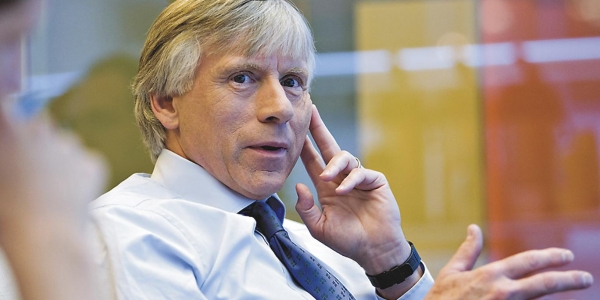
Lee Bollinger's distinctive place in First Amendment theory stems from two different sources. One is his own innovative scholarship, from The Tolerant Society (Oxford University Press, 1986) to Images of a Free Press (University of Chicago Press, 1991) and Eternally Vigilant (University of Chicago Press, 2002, edited with Geoffrey R. Stone). He has now added to it with Uninhibited, Robust, and Wide-Open (Oxford University Press, 2010), an incisive new study—make that hybrid study and manifesto—creatively urging a projection of America's free-speech culture across our globalized world. (See accompanying essay by Bollinger on page B6.)
The other is his role as president since 2002 of Columbia University, where free-speech controversies seem to erupt more spectacularly and frequently than on other campuses. One writes "seem" because it can look that way when two local tabloids, the New York Post and New York Daily News, report First Amendment spats on Morningside Heights so constantly you wonder whether they share a free-expression bureau up there. It also helps when the town you operate in includes the U.N. and serial hate-speech visitors like the Iranian president, Mahmoud Ahmadinejad.
On the theoretical side, Bollinger, despite his leadership posts over the years (he's also been president of the University of Michigan and provost of Dartmouth College), has steadily built upon the foundational ideas he first articulated in The Tolerant Society. There, proceeding from the "extremist speech" issues involved in Skokie and other Supreme Court decisions that he described as "the anvil on which our basic conception of free speech has been hammered out," he had already begun his attention to "social functions of the free-speech idea." Now, in Uninhibited, it has evolved into his real-world focus on how free-speech values operate and should operate in a globalized world.
In The Tolerant Society, Bollinger warned that we should not allow the "continuity of language" in First Amendment jurisprudence to disguise how the meaning of free speech, its "symbolic significance," shifts over time. Like Levy, who berated himself in Emergence of a Free Press for concentrating excessively on what 18th-century Americans said about free speech instead of what they did, Bollinger resists an overly legalistic understanding of free speech while simultaneously trying to synthesize Supreme Court doctrine.
So, in Uninhibited, Bollinger internationalizes the conception of free-speech jurisprudence embedded in his first book, describing it now, in the spirit of Justice Holmes, as "a great social experiment" that "trains us in the art of tolerance and steels us for its vicissitudes." In contending that the United States, through instruments as varied as Supreme Court jurisprudence, international trade law, and international human-rights treaties, should export its free-speech values to the world, Bollinger merges his core First Amendment jurisprudence with the empirical savvy and worldly wisdom he's picked up as Columbia's roaming ambassador around the globe.
Pondering the dilemmas of being a committed free-speech advocate while also running an Ivy League university in the world's 24/7 media capital, Bollinger, chatting in the handsome wood-paneled library of his official presidential home on Morningside Drive (as well as in a follow-up conversation on the phone), rejects the idea that he must regularly compromise his free-expression values with other values important in a university.
"I've never thought of them as clashing," he says. "I have always felt that there were certain fundamental principles—freedom of speech and academic freedom in the context of universities—
And so he briefly lays out out his thinking on Columbia's free-speech controversies of recent years after they're quickly listed before him. The 2006 interruption by students, for instance, of a speech by Jim Gilchrist, founder of the Minuteman Project, an immigrant-unfriendl
All his actions, explains Bollinger, must be understood within the principles for which a great university exists.
"We don't do diplomacy," he asserts. "We're not engaged in having a foreign policy. We do education and research. We are also a forum in which ideas can be expressed, and we try to understand the world." Great universities, in short, already tilt in favor of free speech, but Bollinger notes something many of his critics ignore—that universities must also abide by their own procedural rules.
At Columbia, he says, "students can invite anybody they want and can say whatever they want, basically. ... But faculty and the university, there are limits on what we can do. We don't have the same degree of freedom that students have. We do as citizens, but not as officers or faculty of the institution. We can't, in other words, use the university for political purposes."
"We are an educational, research, scholarly institution," he emphasizes, "and we make decisions about who to invite in the context of that basic mission. ... People don't have a right to come to Columbia or a university and speak."
Much of the time, Bollinger notes, when he's criticized for allowing some controversial speaker at Columbia—Ahmadinejad being the most prominent case—he hasn't issued the invitation himself but is standing up for the right of someone else in the Columbia community to do so. "It is," he states, "absolutely my responsibility to defend that."
In the case of Ahmadinejad, which sparked international headlines praising or condemning Columbia for its decision, Bollinger explains, during the conversation in his house, that he knew he had to engage more directly, acknowledging the behavior of a past tenant of his Columbia mansion. (Nicholas Murray Butler, Columbia's president from 1902 to 1945, has been roundly criticized by scholars for inviting Nazi officials to the campus and treating them courteously.
"I believe that the price of free speech," Bollinger elaborates, "is the responsibility to answer and speak out oneself." He maintains that "the context in which the speaker is going to be permitted to speak is really important. I felt that given the positions Ahmadinejad had taken in the world, the behavior he had engaged in, and the future capability of a person who was prepared to deny the Holocaust in a world forum, it was incumbent upon us to speak to those issues."
So he did it himself, calling the Iranian president "brazenly provocative or astonishingly uneducated," accusing him of exhibiting "all the signs of a petty and cruel dictator," and expressing his own "revulsion" for what Ahmadinejad stood for. A fresh contingent of critics then excoriated Bollinger for his incivility, his violation of standards of courtesy, as if Bollinger had simply channeled his inner Khrushchev. (Some earlier critics against the invitation, in turn, applauded him.) But after reading Bollinger's always thoughtful and respectful prose, sensitive to other points of view, and witnessing his almost reflexive courtesy in the daily functions of a university president, from a luncheon talk honoring an alumnus to how he balances his scheduled phone calls, one senses it must have taken an enormous act of sheer will—not to mention courage—for him to depart from his customary good manners and verbally smash Ahmadinejad in the face.
Some of the principles Bollinger follows in keeping with his free-expression commitments are predictably common-sensical, tolerant, and human. They arguably parallel the New York Times vs. Sullivan opinion he celebrates—the one that declared that an "uninhibited, robust, and wide-open" free-speech culture simply must allow people to make mistakes, to get things wrong. He mentions one of those principles in commenting on criticism he received from the New York Post when Columbia's months-long investigation of students who shut down Gilchrist's talk resulted in what the newspaper felt were slaps on the wrist.
"This is an environment in which young people need to be able to make mistakes," Bollinger says, "and not to suffer the full consequences of those mistakes. People don't like to think about universities as having a special parental responsibility for students. But there is clearly, in my view, a nurturing kind of role that universities must and should have in respect to young people who come into our communities. I think that is very much part of the free-speech issue."
Rodney Smolla, author of Free Speech in an Open Society (Knopf, 1992)—now apparently mirroring Bollinger's career path in ascending to president of Furman University—wryly and aptly titled a key chapter of his magisterial book "The Shortcomings of All Simple Answers." Bollinger plainly agrees with the point, but that hasn't kept him from launching bold prescriptions for how a globalized world might adopt the free speech too many Americans take for granted.
Sophisticated and well traveled, Bollinger knows that his appeal in the new book to extend the same wide-ranging free expression that Supreme Court jurisprudence of the last 90 years has provided the United States is likely to call forth predictable criticisms: that it's a new form of American imperialism, that Americans are already too outspoken for the tastes of others (making "American" free speech an export other countries don't want), that it violates the norms of other cultures.
Bollinger grants that such responses may amount to "a powerful point of view," but is unapologetic: "First of all, we have spent at least a century debating this issue ourselves. ... At the end of the day, we've opted for a society organized along a principle of extraordinary openness. And we believe, I think, that it is rooted not only in a desire to find the truth, and to keep the government honest, but also in a sense that that kind of extraordinary openness will lead to a much more tolerant and creative society."
So he concedes that, yes, in line with free expression, he is saying to others that this "is a good way to live." But that's not his only answer. Bollinger insists that we can no longer think in isolationist terms, that in the modern era "we are utterly dependent and integrated with a broader world." What happens "there" affects us "here," and vice versa. "Censorship anywhere," as he puts it, "is censorship everywhere." In the same mode, he writes in Uninhibited that "when the rights of foreign media are curtailed, our rights are threatened. That's what globalization means ... Americans must, therefore, see the foreign press as our press, as important to the United States as it is to the society in which it resides."
"We need to start from a premise that we believe in something," Bollinger concludes, "open to argument and change, willing to make our case for it, and trying in the context of processes like law and debate and so on to advance that."
Memo to President Ahmadinejad: Remember that American university president who harshly criticized your politics, character, and intellectual courage? Probably just a dim memory at this point, with all the unpleasant things people say about you these days. But he's back, and his new book contains a message for you about the world of globalized media best capsulized by that noted American thinker Joe Louis (though you may be more of a Muhammad Ali fan):
You can run, but you can't hide.
Carlin Romano, critic at large for The Chronicle Review, teaches philosophy and media theory at the University of Pennsylvania.
--
The World's Most Important Visual Holocaust Revisionist Website!
Michael Santomauro
Editorial Director
Call anytime: 917-974-6367
ReporterNotebook@
Amazon's: DEBATING THE HOLOCAUST: A New Look At Both Sides by Thomas Dalton
Secret AIG Document Shows Goldman Sachs Minted Most Toxic CDOs
| | Secret AIG Document Shows Goldman Sachs Minted Most Toxic CDOs aletho | February 23, 2010 at 9:18 am | Categories: Corruption, Deception | URL: http://wp.me/ |
By Richard Teitelbaum | Bloomberg | February 23, 2010
When a congressional panel convened a hearing on the government rescue of American International Group Inc. in January, the public scolding of Treasury Secretary Timothy F. Geithner got the most attention.
Lawmakers said the former head of the New York Federal Reserve Bank had presided over a backdoor bailout of Wall Street firms and a coverup. Geithner countered that he had acted properly to avert the collapse of the financial system.
A potentially more important development slipped by with less notice, Bloomberg Markets reports in its April issue. Representative Darrell Issa, the ranking Republican on the House Committee on Oversight and Government Reform, placed into the hearing record a five-page document itemizing the mortgage securities on which banks such as Goldman Sachs Group Inc. and Societe Generale SA had bought $62.1 billion in credit-default swaps from AIG.
These were the deals that pushed the insurer to the brink of insolvency -- and were eventually paid in full at taxpayer expense. The New York Fed, which secretly engineered the bailout, prevented the full publication of the document for more than a year, even when AIG wanted it released.
That lack of disclosure shows how the government has obstructed a proper accounting of what went wrong in the financial crisis, author and former investment banker William Cohan says. "This secrecy is one more example of how the whole bailout has been done in such a slithering manner," says Cohan, who wrote "House of Cards" (Doubleday, 2009), about the unraveling of Bear Stearns Cos. "There's been no accountability."
CDOs Identified
The document Issa made public cuts to the heart of the controversy over the September 2008 AIG rescue by identifying specific securities, known as collateralized-
The public can now see for the first time how poorly the securities performed, with losses exceeding 75 percent of their notional value in some cases. Compounding this, the document and Bloomberg data demonstrate that the banks that bought the swaps from AIG are mostly the same firms that underwrote the CDOs in the first place.
The banks should have to explain how they managed to buy protection from AIG primarily on securities that fell so sharply in value, says Daniel Calacci, a former swaps trader and marketer who's now a structured-finance consultant in Warren, New Jersey. In some cases, banks also owned mortgage lenders, and they should be challenged to explain whether they gained any insider knowledge about the quality of the loans bundled into the CDOs, he says.
'Too Uncanny'
"It's almost too uncanny," Calacci says. "If these banks had insight into the underlying loans because they had relationships with banks, originators or servicers, that's at the least unethical."
The identification of securities in the document, known as Schedule A, and data compiled by Bloomberg show that Goldman Sachs underwrote $17.2 billion of the $62.1 billion in CDOs that AIG insured -- more than any other investment bank. Merrill Lynch & Co., now part of Bank of America Corp., created $13.2 billion of the CDOs, and Deutsche Bank AG underwrote $9.5 billion.
These tallies suggest a possible reason why the New York Fed kept so much under wraps, Professor James Cox of Duke University School of Law says: "They may have been trying to shield Goldman -- for Goldman's sake or out of macro concerns that another investment bank would be at risk."
Poor Performers
Goldman Sachs spokesman Michael DuVally declined to comment.
Schedule A also makes possible a more complete examination of why AIG collapsed. Joseph Cassano, the former president of the AIG Financial Products unit that sold the swaps, said on a December 2007 conference call that his firm pulled back from selling swaps on U.S. subprime residential CDOs in late 2005. The list shows that the $21.2 billion in CDOs minted after 2005, mostly based on prime and commercial mortgages, performed as badly as or worse than the earlier subprime vintages.
A lawyer for Cassano declined to comment.
As details of the coverup emerge, so does anger at the perceived conflicts. Philip Angelides, chairman of the Financial Crisis Inquiry Commission, at a hearing held by his panel on Jan. 13, questioned how banks could underwrite poisonous securities and then bet against them. "It sounds to me a little bit like selling a car with faulty brakes and then buying an insurance policy on the buyer of those cars," he said.
'Part of the Coverup'
Janet Tavakoli, founder of Tavakoli Structured Finance Inc., a Chicago-based consulting firm, says the New York Fed's secrecy has helped hide who's responsible for the worst of the disaster. "The suppression of the details in the list of counterparties was part of the coverup," she says.
E-mails between Fed and AIG officials that Issa released in January show that the efforts to keep Schedule A under wraps came from the New York Fed. Revelation of the messages contributed to the heated atmosphere at the House hearing.
"What date did you know there was a coverup?" Republican Congressman Brian Bilbray of California demanded of Geithner. Lawmakers used the word coverup more than a dozen times as they peppered Geithner with questions.
Geithner said that he wasn't involved in matters of disclosure and that his former colleagues did the best they could. In a Jan. 19 statement, the New York Fed said, "AIG at all times remained responsible for complying with its disclosure requirements under the securities laws."
The government has committed more than $182 billion to AIG and owns almost 80 percent of the company.
Document Withheld
In late November 2008, the insurer was planning to include Schedule A in a regulatory filing -- until a lawyer for the Fed said it wasn't necessary, according to the e-mails. The document was an attachment to the agreement between AIG and Maiden Lane III, the fund that the Fed established in November 2008 to hold the CDOs after the swap contracts were settled.
AIG paid its counterparties -- the banks -- the full value of the contracts, after accounting for any collateral that had been posted, and took the devalued CDOs in exchange. As requested by the New York Fed, AIG kept the bank names out of the Dec. 24 filing and edited out a sentence that said they got full payment.
The New York Fed's January 2010 statement said the sentence was deleted because AIG technically paid slightly less than 100 cents on the dollar.
Paid in Full
Before the New York Fed ordered AIG to pay the banks in full, the company was trying to negotiate to pay off the credit- default swaps at a discount or "haircut."
By March 2009, responding to a request from Christopher Dodd, chairman of the Senate Committee on Banking, Housing and Urban Affairs, AIG released the names of the counterparty banks. In a filing later that month, AIG included Schedule A, showing bank names while withholding all identification of the underlying CDOs and the amounts of collateral each bank had collected. The document had more than 800 redactions.
In May 2009, AIG again filed Schedule A, this time with about 400 redactions. It revealed that Paris-based Societe Generale got the biggest payout from AIG, or $16.5 billion, followed by Goldman Sachs, which got $14 billion, and then Deutsche Bank and Merrill Lynch. It still kept secret the CDOs' identification and information that would show performance.
'Right to Know'
"This is something that belongs in the public domain because it was done with public money," Issa says. "The public has the right to know what was done with their money and who benefited from it." Now, thanks to Issa, the list is out, and specific information about AIG's unraveling can be learned from it.
At the Jan. 27 hearing, the New York Fed was still arguing that the contents of Schedule A shouldn't be fully disclosed. Thomas Baxter, the New York Fed's general counsel, testified that divulging the names of the CDOs could erode their value: "We will be hurt because traders in the market will know what we're holding."
Tavakoli calls that wrong. With many CDOs, providing more information to the market will give the manager a greater chance of fetching a realistic price, she says.
Jack Gutt, a spokesman for the New York Fed, declined to comment, as did AIG's Mark Herr.
Bad to Worse
Tavakoli also says that the poor performance of the underlying securities (which are actually specific slices or tranches of CDOs) shows they were toxic in the first place and were probably replenished with bundles of mortgages that were particularly troubled. Managers who oversee CDOs after they are created have discretion in choosing the mortgage bonds used to replenish them.
"The original CDO deals were bad enough," Tavakoli says. "For some that allow reinvesting or substitution, any reasonable professional would ask why these assets were being traded into the portfolio. The Schedule A shows that we should be investigating these deals."
Among the CDOs on Schedule A with notional values of more than $1 billion, the worst performer was a tranche identified as Davis Square Funding Ltd.'s DVSQ 2006-6A CP. It was held by Societe Generale, underwritten by Goldman Sachs and managed by TCW Group Inc., a Los Angeles-based unit of SocGen, according to Bloomberg data. It lost 77.7 percent of its value -- though it isn't in default and continues to pay.
SocGen spokesman James Galvin and TCW spokeswoman Erin Freeman declined to comment.
Documentation Needed
Ed Grebeck, CEO of Tempus Advisors, a global debt market strategy firm in Stamford, Connecticut, agrees that more digging is necessary. "You need all the documentation and more than that, all the e-mails," he says. "That would allow us to understand what went wrong and how to fix it going forward."
Neil Barofsky, the special inspector general for the Troubled Asset Relief Program, who delivered a report on the AIG bailout in November, says he's not finished. He has begun a probe of why his office wasn't provided all of the 250,000 pages of documents, including e-mails and phone logs, that Issa's committee received from the New York Fed.
Schedule A provides some answers -- and raises questions that need to be tackled to avoid the next expensive bailout.
To contact the reporter on this story: Richard Teitelbaum in New York at rteitelbaum1@

--
The World's Most Important Visual Holocaust Revisionist Website!
Michael Santomauro
Editorial Director
Call anytime: 917-974-6367
ReporterNotebook@
Amazon's: DEBATING THE HOLOCAUST: A New Look At Both Sides by Thomas Dalton