Translate

Oct 30, 2010

Obama in Command: The Rolling Stone Interview


Obama in Command:
The Rolling Stone Interview

In an Oval Office interview, the president discusses the Tea Party, the war, the economy and what's at stake this November

By  Jann S. Wenner
Sep 28, 2010 7:00 AM EDT

The following is an article from the October 15, 2010 issue of Rolling Stone.

We arrived at the southwest gate of the white house a little after one o'clock on the afternoon of September 17th. It was a warm fall day, but the capital felt quiet and half-empty, as it does on Fridays at the end of summer, with Congress still in recess. Rolling Stone had interviewed Barack Obama twice before, both times aboard his campaign plane — first in June 2008, a few days after he won the Democratic nomination, and again that October, a month before his election. This time executive editor Eric Bates and I sat down with the president in the Oval Office, flanked by busts of Abraham Lincoln and Martin Luther King Jr. The conversation stretched on for nearly an hour and a quarter. The president began by complimenting my multi-colored striped socks. "If I wasn't president," he laughed, "I could wear socks like that."

When you came into office, you felt you would be able to work with the other side. When did you realize that the Republicans had abandoned any real effort to work with you and create bipartisan policy?
Well, I'll tell you that given the state of the economy during my transition, between my election and being sworn in, our working assumption was that everybody was going to want to pull together, because there was a sizable chance that we could have a financial meltdown and the entire country could plunge into a depression. So we had to work very rapidly to try to create a combination of measures that would stop the free-fall and cauterize the job loss.

The recovery package we shaped was put together on the theory that we shouldn't exclude any ideas on the basis of ideological predispositions, and so a third of the Recovery Act were tax cuts. Now, they happened to be the most progressive tax cuts in history, very much geared toward middle-class families. There was not only a fairness rationale to that, but also an economic rationale — those were the folks who were most likely to spend the money and, hence, prop up demand at a time when the economy was really freezing up.

I still remember going over to the Republican caucus to meet with them and present our ideas, and to solicit ideas from them before we presented the final package. And on the way over, the caucus essentially released a statement that said, "We're going to all vote 'No' as a caucus." And this was before we'd even had the conversation. At that point, we realized that we weren't going to get the kind of cooperation we'd anticipated. The strategy the Republicans were going to pursue was one of sitting on the sidelines, trying to gum up the works, based on the assumption that given the scope and size of the recovery, the economy probably wouldn't be very good, even in 2010, and that they were better off being able to assign the blame to us than work with us to try to solve the problem.

How do you feel about the fact that day after day, there's this really destructive attack on whatever you propose? Does that bother you? Has it shocked you?
I don't think it's a shock. I had served in the United States Senate; I had seen how the filibuster had become a routine tool to slow things down, as opposed to what it used to be, which was a selective tool — although often a very destructive one, because it was typically targeted at civil rights and the aspirations of African-Americans who were trying to be freed up from Jim Crow. But I'd been in the Senate long enough to know that the machinery there was breaking down.

What I was surprised somewhat by, and disappointed by, although I've got to give some grudging admiration for just how effective it's been, was the degree to which [Senate Minority Leader] Mitch McConnell was able to keep his caucus together on a lot of issues. Eventually, we were able to wear them down, so that we were able to finally get really important laws passed, some of which haven't gotten a lot of attention — the credit-card reform bill, or the anti-tobacco legislation, or preventing housing and mortgage fraud. We'd be able to pick off two or three Republicans who wanted to do the right thing.

But the delays, the cloture votes, the unprecedented obstruction that has taken place in the Senate took its toll. Even if you eventually got something done, it would take so long and it would be so contentious, that it sent a message to the public that "Gosh, Obama said he was going to come in and change Washington, and it's exactly the same, it's more contentious than ever." Everything just seems to drag on — even what should be routine activities, like appointments, aren't happening. So it created an atmosphere in which a public that is already very skeptical of government, but was maybe feeling hopeful right after my election, felt deflated and sort of felt, "We're just seeing more of the same."

What do you think the Republican Party stands for today?
Well, on the economic front, their only agenda seems to be tax cuts for the wealthiest Americans. If you ask their leadership what their agenda will be going into next year to bring about growth and improve the job numbers out there, what they will say is, "We just want these tax cuts for the wealthiest Americans, which will cost us $700 billion and which we're not going to pay for."

Now what they'll also say is, "We're going to control spending." But of course, when you say you're going to borrow $700 billion to give an average $100,000-a-year tax break to people making a million dollars a year, or more, and you're not going to pay for it; when Mitch McConnell's overall tax package that he just announced recently was priced at about $4 trillion; when you, as a caucus, reject a bipartisan idea for a fiscal commission that originated from Judd Gregg, Republican budget chair, and Kent Conrad, Democratic budget chair, so that I had to end up putting the thing together administratively because we couldn't get any support — you don't get a sense that they're actually serious on the deficit side.

What do you think of the Tea Party and the people behind it?
I think the Tea Party is an amalgam, a mixed bag of a lot of different strains in American politics that have been there for a long time. There are some strong and sincere libertarians who are in the Tea Party who generally don't believe in government intervention in the market or socially. There are some social conservatives in the Tea Party who are rejecting me the same way they rejected Bill Clinton, the same way they would reject any Democratic president as being too liberal or too progressive. There are strains in the Tea Party that are troubled by what they saw as a series of instances in which the middle-class and working-class people have been abused or hurt by special interests and Washington, but their anger is misdirected.

And then there are probably some aspects of the Tea Party that are a little darker, that have to do with anti-immigrant sentiment or are troubled by what I represent as the president. So I think it's hard to characterize the Tea Party as a whole, and I think it's still defining itself.

http://www.rollingstone.com/politics/news/17390/209395

__._,_.___
Recent Activity:
.

__,_._,___

Alan Hart: Is Rupert Murdoch ignorant or an agent of Zionist deception? [1 Attachment]

 
[Attachment(s) from ReporterNotebook included below]


From: Alan Hart <alan_hart_esq@btinternet.com>
Date: Sat, Oct 30, 2010 at 4:45 AM
Subject: Submission
To: Alan Hart <alan_hart_esq@btinternet.com>


Regards to all

Alan
 
-------------------------------------------
Subscribe to my blog: http://www.alanhart.net/subscribe
Follow me on Twitter: http://twitter.com/alanauthor

Is Rupert Murdoch ignorant or an agent of Zionist deception?  

By Alan Hart 

In a recent speech at an ADL (Anti-Defamation League) dinner, Rupert Murdoch, arguably the most influential mainstream media chief on Planet Earth, made some extraordinary statements which must be challenged. But first it's necessary for us all to be clear about what ADL's role is. 

Its proclaimed objective is to "fight anti-Semitism". In reality its main purpose under the leadership of Abe Foxman is to smear, harass, silence and preferably destroy those of all faiths and none who are critical of Zionism in action - critical of Israel's policies in general and its contempt for international law in particular; and critical of the awesome power of the Zionist lobby, in America especially. 

In his speech Murdoch said his own perspective on the evil of anti-Semitism was "simple". He put it this way (my emphasis added): 

    "We live in a world where there is an ongoing war against the Jews. For the first decades after Israel's founding, this war was conventional in nature. The goal was straightforward - to use military force to overrun Israel."  

That was Murdoch's carefully understated way of endorsing Zionism's assertion that for the first decades of its life Israel lived in danger of annihilation, the "driving into the sea" of its Jews. As I document in detail through the three volumes of the American edition of my book Zionism: The Real Enemy of the Jews, Israel's existence was never, ever, in danger from any combination of Arab force. Zionism's assertion to the contrary was the cover that allowed Israel to get away where it mattered most (in America and Western Europe) with presenting its aggression as self-defense and itself as the victim when, actually, it was and is the oppressor. 

The main event during the period in which Murdoch asserted that the Arabs were trying to "overrun" Israel was the 1967 war. Zionism's story of it, which the mainstream media still peddles to this day, is that Israel went to war either because the Arabs attacked first or were intending to attack. Both, the either and the or, are Zionist propaganda nonsense. It was a war of Israeli aggression. 

I don't expect Murdoch to pay any attention to what the Gentile me has to say on the subject, but if he is not an agent of Zionist deception (i.e. if he is merely ignorant), he ought to consider what various Israeli leaders have said. I quote them in America Takes Sides, War With Nasser Act II and the Creation of Greater Israel, Chapter 1 of Volume Three the American edition of my book, which is sub-titled Conflict Without End? 

I preface the quotes of Israeli leaders with this observation. 

"If the statement that the Arabs were not intending to attack Israel and that the existence of the Jewish state was not in danger was only that of a goy, it could be dismissed by Zionists as anti-Semitic conjecture. In fact the truth the statement represents was admitted by some of the key Israeli players - after the war, of course. Before we look at what actually happened in 1967 and why, here is a short summary of some pertinent, post-war Israeli confessions."   

    In an interview published in Le Monde on 28 February 1968, Israeli Chief of Staff Rabin said this: "I do not believe that Nasser wanted war. The two divisions which he sent into Sinai on 14 May would not have been enough to unleash an offensive against Israel. He knew it and we knew it."   

    On 14 April 1971, a report in the Israeli newspaper Al-Hamishmar contained the following statement by Mordecai Bentov, a member of the wartime national government. "The entire story of the danger of extermination was invented in every detail and exaggerated a posteriori to justify the annexation of new Arab territory."   

    On 4 April 1972, General Haim Bar-Lev, Rabin's predecessor as chief of staff, was quoted in Ma'ariv as follows: "We were not threatened with genocide on the eve of the Six-Days war, and we had never thought of such a possibility."   

    In the same Israeli newspaper on the same day, General Ezer Weizman, Chief of Operations during the war and a nephew of Chaim Weizman, was quoted as saying: "There was never any danger of annihilation. This hypothesis has never been considered in any serious meeting."   

    In the spring of 1972, General Matetiyahu Peled, Chief of Logistical Command during the war and one of 12 members of Israel's General Staff, addressed a political literary club in Tel Aviv. He said: "The thesis according to which the danger of genocide hung over us in June 1967, and according to which Israel was fighting for her very physical survival, was nothing but a bluff which was born and bred after the war." In a radio debate Peled said: "Israel was never in real danger and there was no evidence that Egypt had any intention of attacking Israel." He added that "Israeli intelligence knew that Egypt was not prepared for war."   

    In the same program Chaim Herzog (former DMI, future Israeli Ambassador to the UN and President of his state) said: "There was no danger of annihilation. Neither Israeli headquarters nor the Pentagon - as the memoirs of President Johnson proved - believed in this danger."   

    On 3 June 1972 Peled was even more explicit in an article of his own for Le Monde. He wrote: "All those stories about the huge danger we were facing because of our small territorial size, an argument expounded once the war was over, have never been considered in our calculations. While we proceeded towards the full mobilisation of our forces, no person in his right mind could believe that all this force was necessary to our 'defense' against the Egyptian threat. This force was to crush once and for all the Egyptians at the military level and their Soviet masters at the political level. To pretend that the Egyptian forces concentrated on our borders were capable of threatening Israel's existence does not only insult the intelligence of any person capable of analyzing this kind of situation, but is primarily an insult to the Israeli army."   

    The preference of some generals for truth-telling after the event provoked something of a debate in Israel, but it was short-lived. If some Israeli journalists had had their way, the generals would have kept their mouths shut. Weizman was one of those approached with the suggestion that he and others who wanted to speak out should "not exercise their inalienable right to free speech lest they prejudice world opinion and the Jewish diaspora against Israel."  

    It is not surprising that debate in Israel was shut down before it led to some serious soul-searching about the nature of the state and whether it should continue to live by the lie as well as the sword; but it is more than remarkable, I think, that the mainstream Western media continues to prefer the convenience of the Zionist myth to the reality of what happened in 1967 and why. When reporters and commentators have need today to make reference to the Six Days War, they still tell it like the Zionists said it was in 1967 rather than how it really was. Obviously there are still limits to how far the mainstream media is prepared to go in challenging the Zionist account of history, but it could also be that lazy journalism is a factor in the equation.   

    For those journalists, lazy or not, who might still have doubts about who started the Six Days War, here's a quote from what Prime Minister Begin said in an unguarded, public moment in 1982.  "In June 1967 we had a choice. The Egyptian army concentrations in the Sinai approaches did not prove that Nasser was really about to attack us, We must be honest with ourselves. We decided to attack him."  

My own favourite Israeli quote is the one I use to draw the Prologue to Volume One of my book to a conclusion. In 1980 I had a number of conversations with the best and the brightest of Israel's Directors of Military Intelligence, Major General (then retired) Sholmo Gazit. Over coffee one morning I said to him: "I've come to the conclusion that it's all a myth. Israel's existence has never, ever, been in danger." He replied: "The trouble with us Israelis is that we've become the victims of our own propaganda." 

In his speech to the ADL dinner, Murdoch said that phase two of the "ongoing war against the Jews" (after the failure to "overrun" Israel by force) was "terrorism" He seems to have no idea of reality on this front either.  

One of a number of summary truths about terrorism is this. In Palestine that became Israel, it was the Zionists who turned to terrorism first - to drive out the occupying British and then the indigenous Arabs. 

Murdoch spoke of the terrorists targeting Israelis at home and broad - "from the massacre of Israeli athletes at Munich to the second intifada." Fact: All but two of the Israeli athletes in Munich were killed by German security forces after Israeli Defense Minister Dayan insisted, against Prime Minister Golda Meir's own best judgement, on a shoot-out to prevent a negotiated end to the hostage drama. Fact: The second intifada, which PLO Chairman Arafat was doing his best to prevent, was provoked by Ariel Sharon to improve his prospects of becoming prime minister by seeing off a challenge from Netanyahu. 

A second summary truth about Palestinian terrorism is this. The Palestinians were not and are not "at war with the Jews". Black September's Munich operation, for example, was terrorism for a public relations purpose - to draw the attention of the world to the fact that the Palestinians existed, were occupied and oppressed and in need of some justice. 

A summary truth about general Arab and wider Muslim terrorism is this. It is primarily a response of the weak and oppressed to Israel's arrogance of power and insufferable self-righteousness; to the impotence, corruption and repression of Arab and other Muslim regimes which are correctly regarded by their masses as little more than puppets of America-and-Zionism; and to the deadly double-standard of Western foreign policy - in particular its unconditional support for Israel right or wrong. (In at least one respect the  Arab and other Muslim masses have much more wisdom than Western leaders. They, Arab and Muslims masses, know that unconditional support for Israel right or wrong is not in anybody's best interests, not even those of Israel's Jews). 

According to Murdoch "the war against the Jews" has now entered a new phase. "This," he said, "is the soft war that seeks to isolate Israel by delegitimizing it. The battleground is everywhere - the media… multinational organizations … NGOs. In this war, the aim is to make Israel a pariah." 

It is true that in the eyes of many if not most peoples of the world (and probably many of their governments behind closed doors) Israel is increasingly being seen as a pariah state. But that's a consequence of Israel's policies and actions, war crimes and all. 

What Murdoch sees as the rise of anti-Semitism is, in fact, the rise of anti-Israelism. The danger for the Jews of the world is that it will be transformed into violent anti-Semitism at a foreseeable point in the future if the Zionist state is not called and held to account for its past crimes and is allowed by the major powers to go on committing new ones. 

It is a fact that prior to the obscenity of the Nazi holocaust, most Jews were opposed to Zionism's colonial enterprise. One of their fears was that Zionism would one day provoke anti-Semitism if it was allowed by the big powers to have its way. As I never tire of writing and saying, this fear was given a fresh airing by Yehoshafat Harkabi, Israel's longest serving Director of Military Intelligence. In 1986 he published a remarkable book, Israel's Fateful Hour. It contains this warning (my emphasis added): 

    Israel is the criterion according to which all Jews will tend to be judged. Israel as a Jewish state is an example of the Jewish character, which finds free and concentrated expression within it. Anti-Semitism has deep and historical roots. Nevertheless, any flaw in Israeli conduct, which initially is cited as anti-Israelism, is likely to be transformed into empirical proof of the validity of anti-Semitism. It would be a tragic irony if the Jewish state, which was intended to solve the problem of anti-Semitism, was to become a factor in the rise of anti-Semitism. Israelis must be aware that the price of their misconduct is paid not only by them but also Jews throughout the world. 

Nearly a quarter of a century on I think it can and should be said that Israel's "misconduct" has become the prime factor in the equation that could transform anti-Israelism into anti-Semitism. 

If I had the opportunity to address Mr. Murdoch directly, I would say to him the following. If you really care about the Jews (I mean the Jews as people as opposed to their money), you would put your media empire at the service of the truth of history.  

I would also tell him that when I joined ITN (Independent Television News) as a very young reporter many years ago, its great editor-in-chief, Geoffrey Cox, gave me the mission statement in one short sentence. "Our job is to help keep democracy alive." 

I would then say to Murdoch that my charge today is (generally speaking) that the mainstream media has betrayed democracy. And I would add, "You, sir, are the greatest betrayer, traitor, of them all."  


--

Being happy–is it good for the Jews? "Before Professor Dershowitz accused me of being an anti-Semite (news to me), I was a happy person. Since then, I'm still a happy person". –Michael Santomauro

An antisemite condemns people for being Jews, I am not an antisemite.--Michael Santomauro

Most of us are mentally trapped to think Jewish. Actually, it is safe to say that virtually every mainstream publication or or other type of media organ is "nothing more than a screen to present chosen views." The great battle over the last century has been a battle for the mind of the Western peoples, i.e., non-Jewish Euros. The chosen won it by acquiring control over essentially the complete mainstream news, information, education and entertainment media of every type, and using that control to infuse and disseminate their message, agenda and worldview, their way of thinking, or rather the way they want us to think. Since at least the 1960s this campaign has been effectively complete. Since then they have shaped and controlled the minds of all but a seeming few of us in varying degree with almost no opposition or competition from any alternative worldview. So now most of us are mentally trapped in the box the chosen have made for us, which we have lived in all our lives. Only a few have managed to avoid it or escape it, or to even sometimes see outside of it, and so actually "think outside of the (Jewish) box." --Michael Santomauro

Thank you and remember: 

Peace is patriotic!

Michael Santomauro
253 W. 72nd Street
New York, NY 10023

Call anytime: 917-974-6367

E-mail me anything:
ReporterNotebook@Gmail.com

__._,_.___

Attachment(s) from ReporterNotebook

1 of 1 File(s)

Recent Activity:
MARKETPLACE

Get great advice about dogs and cats. Visit the Dog & Cat Answers Center.


Hobbies & Activities Zone: Find others who share your passions! Explore new interests.


Stay on top of your group activity without leaving the page you're on - Get the Yahoo! Toolbar now.

.

__,_._,___

George Bush thought 9/11 plane had been shot down on his orders


George Bush thought 9/11 plane had been shot down on his orders

Memoirs reveal former US president gave order to shoot down any hijacked planes before United Airlines flight 93 crashed

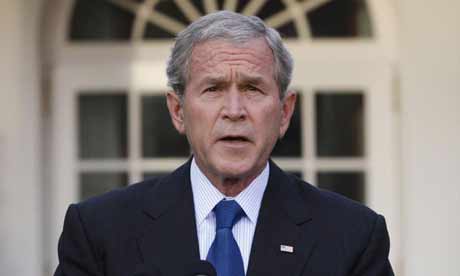
George Bush
George Bush initially thought United Airlines flight 93 had been shot down in Pennsylvania. Photograph: Jason Reed/Reuters

George Bush initially believed the only plane not to reach its intended target during the 11 September attacks had been shot down on his orders, according to leaks from the former president's memoir of his two terms in office.

Bush reveals that he gave the order for any further suspected hijacked planes to be shot down after the first aircraft were flown into the World Trade Centre in New York during the 2001 terror attacks.

He at first thought the crash of United Airlines flight 93 in Pennsylvania had resulted from this instruction, although it later emerged that passengers had stormed the cockpit as hijackers flew the plane towards the Capitol building in Washington.

The memoir, Decision Points, is due to be published on 9 November, in the aftermath of the US midterm elections, and Bush is already lined up for interviews on the Oprah Winfrey and NBC Today shows.

The Drudge Report website says the very personal book opens with the line: "It was a simple question: 'Can you remember the last day you didn't have a drink?'" as Bush deals with the well-known issue of his alcohol consumption.

His drinking has previously been said to have come to an end when he woke up with a hangover following his 40th birthday celebrations.

In a chapter about stem cell research, he describes receiving a letter from Nancy Reagan detailing a "wrenching family journey", but says: "I did feel a responsibility to voice my pro-life convictions and lead the country toward what Pope John Paul II called a culture of life."

Bush goes on to describes an emotional July 2001 meeting with the Pope, who had Parkinson's disease, at the pontiff's summer residence.

The Pope reportedly recognised the promise of science but implored Bush to support life in all its forms.

At the pontiff's funeral in 2005, Bush – after a reminder from his wife, Laura, that it was a time to "pray for miracles" – said a prayer for the ABC news anchor Peter Jennings, who had cancer.

The book is said to stay clear of criticising Barack Obama, and a source told the Drudge Report: "You will find the president strong, loving life, and ultimately at peace with the decisions he made."

http://www.guardian.co.uk/world/2010/oct/29/george-bush-thought-9-11-plane-shot-down

F l i g h t   9 3

Original New Hampshire newspaper article dated September 13th, 2001.

Thursday, September 13, 2001

FAA worker says hijacked jetliners almost collided before striking World Trade Center

By ALBERT McKEON, Telegraph Staff
mckeona@telegraph-nh.com
<b>Staff photo by Dean Shalhoup</b><br>Several Nashua police officers block the entrance to the Boston Air Traffic Control Center on Northeastern Boulevard in Nashua Tuesday morning where they rushed shortly after two passenger aircraft that departed from Boston crashed into the World Trade Center buildings in New York.
Staff photo by Dean Shalhoup
Several Nashua police officers block the entrance to the Boston Air Traffic Control Center on Northeastern Boulevard in Nashua Tuesday morning where they rushed shortly after two passenger aircraft that departed from Boston crashed into the World Trade Center buildings in New York.


Story Index
| Forum

The two hijacked jets that sliced into the World Trade Center nearly crashed into each other before reaching New York City, according to a Federal Aviation Administration employee who works in the Nashua control facility.

FAA air traffic controllers in Nashua have learned through discussions with other controllers that an F-16 fighter stayed in hot pursuit of another hijacked commercial airliner until it crashed in Pennsylvania, said the employee, who spoke on the condition of anonymity.

By 10:30 a.m. on Tuesday, the military had taken control of U.S. airspace, the employee said. The jet crashed into a field at 10:37 a.m.

The incidents fell in line with a handful of incredible and unprecedented events that unfolded in America on Tuesday, said the employee, who worked in the control center that fateful morning. The center is one of 20 FAA facilities that monitor long-distance flights once they leave airports.

The morning's surreal moments included a controller, who had just arrived for work, discovering that his wife's American Airline flight was involved in the day of terror, the employee said.

Controllers never expected that the terrorists who hijacked the plane had their sights set on the north tower of the World Trade Center, the employee said.

Even as the tower burned, controllers still hadn't concluded that another hijacked plane - United Airlines Flight 175 - would slam into the other New York skyscraper, the employee said.

The terrorists, however, nearly had their plans dashed when the two planes almost collided outside the city, the employee said. "The two aircraft got too close to each other down by Stewart" International Airport in New Windsor, N.Y., the employee said.

Controllers have also learned that an F-16 fighter closely pursued hijacked United Airlines Flight 93 until it crashed in southwestern Pennsylvania, the employee said.

Although controllers don't have complete details of the Air Force's chase of the Boeing 757, they have learned the F-16 made 360-degree turns to remain close to the commercial jet, the employee said.

"He must've seen the whole thing," the employee said of the F-16 pilot's view of Flight 93's crash.

One air traffic controller - with the help of an assistant - monitored the flight patterns of the two jets that toppled the World Trade Center, the employee said. He directed American Airlines Flight 11 and United Airlines Flight 175 - both Boeing 767 jets that had Boston to Los Angeles routes, the employee said.

The same controller handled Egypt Air Flight 990 when it crashed off the coast of Massachusetts in 1999, the employee said. Hijackers gained control of American Airlines Flight 11 around Gardner, Mass., the employee said. "American was just flying around, doing what it wanted," the employee said of the jet's approach to New York.

United Airlines Flight 175 remained in the hands of its pilots until Albany, N.Y., the employee said. Terrorists apparently seized United Airlines Flight 93 late in its interrupted route, the employee said.

The controller in charge of flights 11 and 175 noticed the American Airlines plane had encountered difficulties when its transponder - the device that sends an electrical radar pulse to air traffic control centers - shut off, the employee said. At that point, the plane veered from its course west, the employee said.

Soon after, the controller realized a hijacker stood in the cockpit when the plane's captain - John Ogonowski of Dracut, Mass. - turned on his microphone, the employee said. Ogonowski activated the microphone so the FAA could hear the terrorists' threats, the employee said.

The controller heard someone instruct, "'Nobody do anything stupid'" and no one would get hurt, the employee said. After that, the controller heard no more conversations, the employee said.

"That's all that was heard," the employee said. When it became apparent the plane had fallen into the hands of hijackers, a third controller began helping the controller and his assistant, a procedure followed during all hijackings, the employee said. FAA controllers also notified concerned government organizations such as the military, the employee said.

Then, controllers shut down all other air traffic quickly, the employee said.

But many of the aircraft didn't immediately answer FAA calls, the employee said.

Planes flying through the Nashua center's airspace on their way to Georgia or Florida were told to land at other airports and avoid the airspace of the hijacked flights, the employee said.

The controller spoke with United Airlines Flight 175 for quite some time after terrorists took command of American Airlines Flight 11, the employee said. FAA controllers never expected Flight 175 to hit the second World Trade Center tower because of that sustained contact with the crew, the employee said.

"It's not in anyone's mind they're hitting a target," the employee said. "When somebody takes a plane over, they try to negotiate a release with money," the employee said.

Many controllers also watched events unfold on the control center's television, the employee said.

"After the first plane hit, nobody imagined it would happen again," the employee said. "We all thought that was it. It totally caught everybody off guard."

The controller is "pretty disturbed" that he lost both planes, the employee said. He handled both flights because they shared similar routes on their intended journey to Los Angeles, the employee said.

Other controllers will handle the disasters in other ways, the employee said.

But controllers can feel rather helpless after such a tragedy because they "are just a voice in the air," the employee said. "You can't do anything."

Controllers will rally around each other, the employee said. Controllers are very supportive of one another, the employee said.

They are "like family - sitting shoulder to shoulder 40 hours a week," the employee said.

The employee wouldn't identify the controller who lost his wife, or her name.

She was a businesswoman who had just missed her flight the night before, the employee said.

"We're waiting to see what happens next," the employee said of the country's concern about the potential of more terrorist air attacks. "It pretty much opens the door to a bunch of stuff going on," the employee said of the terrorists' use of planes as weapons.

Albert McKeon can be reached at 249-3339.

http://www.web.archive.org/web/20031018152433/http://www.investigate911.com/flight93.htm

 
The FBI's later explanation for the white jet was that a passing civilian Fairchild Falcon 20 jet was asked to descend from 34,000ft to 5,000ft some minutes after the crash to give co-ordinates for the site. The plane and pilot have never been produced or identified. Susan Mcelwain says a Falcon 20 was not the plane she saw.
 
The FBI insists there was no military plane in the area but at 9.22am a sonic boom - caused by a supersonic jet - was picked up by an earthquake monitor in southern Pennsylvania, 60 miles away from Shanksville.
 
2) Lee Purbaugh: There was another plane," Lee said. "I didn't get a good look but it was white and it circled the area about twice and then it flew off over the horizon."
 
3) Tom Spinelli: "I saw the white plane," "It was flying around all over the place like it was looking for something. I saw it before and after the crash."
 
4) Dennis Decker, 5) Rick Chaney: About a mile north on Buckstown Road, Dennis Decker and Rick Chaney were at work making wooden pallets when they heard an explosion and came running outside to watch a large mushroom cloud spreading over the ridge." As soon as we looked up, we saw a midsized jet flying low and fast," Decker said. "It appeared to make a loop or part of a circle, and then it turned fast and headed out. " Decker and Chaney described the plane as a Lear-jet type, with engines mounted near the tail and painted white with no identifying markings. "If you were here to see it, you'd have no doubt," Decker said. "It was a jet plane, and it had to be flying real close when that 757 went down. If I was the FBI, I'd find out who was driving that plane. "
 
6) Robin Doppstadt: Robin Doppstadt was working inside her family food-and-supply store when she heard the crash. When she went outside, she said, she saw a small white jet that looked like it was making a single circle over the crash site. "Then it climbed very quickly and took off. "
 
7) Dale Browning who witnessed the white plane, "the damndest darn thing", remarked:
"Everybody's seen this thing in the sky, but no one can tell us what it is."
 
8) Jim Brant: Mr. Brant and two of his employees arrived at the site in minutes , hoping to help survivors. He said he noticed a white plane, perhaps a jet, circling the wreckage. "It reminded me of a fighter jet," he said. He said it stayed there for one or two minutes before leaving. "The plane had no markings on it, either civilian or military."
 
9) John Feegle: "It didn't look like a commercial plane," Feegle said. "It had a real goofy tail on it, like a high tail. It circled around, and it was gone." "The aircraft appeared to have an unusually tall vertical stabilizer."
 
THE PHILADELPHIA DAILY NEWS:
 
10) Kathy Blades and her son ran outside after the crash and saw the jet, with sleek back wings and an angled cockpit, race overhead.

Here is the text as it once appeared at PittsburghLive.com (Pittsburgh's website)
on Friday September 14th, 2001. The first page still online:
http://www.pittsburghlive.com/images/static/pdf/gtr091401.pdf

Authorities deny Flight 93
was shot down by F-16

By Richard Gazarik and Robin Acton
TRIBUNE-REVIEW


Federal investigators hope the flight data recorder recovered from United
Airlines Flight 93 will reveal what caused the Boeing 757 jetliner to crash into
an abandoned Somerset County strip mine in a deadly sequence of terrorist
attacks.

FBI Agent William Crowley announced Thursday afternoon that investigators using
heavy equipment found the recorder in a crater at the crash site near
Lambertsville in Stonycreek Township.

The device that electronically records the aircraft's instruments in the final
moments before a plane crashes was packaged for transport to Washington, D.C.,
for analysis by officials from the National Transportation Safety Board, Crowley
said.

Searchers yesterday also found one of the hijacked jetliner's engines. But by
evening, the cockpit voice recorder had not been recovered.

Meanwhile, speculation continued to swirl around reports that a military fighter
jet was seen in the vicinity immediately after the crash.

According to the Nashua (N.H.) Telegraph, FAA employees at an air-traffic
control center near Boston learned from controllers at other facilities that an
F-16 "stayed in hot pursuit" of the 757.

By 10:30 a.m. Tuesday, the Air Force had taken control of all U.S. airspace, the
unidentified controller told the Telegraph. A few minutes later, the Boeing
crashed in Stonycreek Township.

The F-16 made 360-degree turns to stay close to the 757, the Telegraph reported.
"He must've seen the whole thing," the FAA employee said of the F-16's pilot.

Crowley confirmed that there were two other aircraft within 25 miles of the
United flight that were heading east when it crashed, scattering debris over 8
miles.

He did not know the types of planes, nor could he discuss the altitudes at which
they were flying.

Military planes sometimes "shadow" airliners that are in trouble or have lost
radio communications, as part of efforts to re-establish contact.

An Air Force spokeswoman at North American Aerospace Defense Command in
Colorado, Capt. Adriane Craig, said the military could neither confirm nor deny
whether an airplane was following the United 757.

Neither NORAD nor the Air Force releases information about where its jets are
flying at any given time, or what their patrol routes are over metropolitan
areas, Craig said.

Crowley discounted rumors that the military shot down the jetliner in a sparsely
populated area to keep it away from the White House and other possible targets
in Washington, D.C.

"There was no military involvement," Crowley said.

NORAD issued its own denial yesterday afternoon, "confirm(ing) that the United
Airlines jetliner that crashed outside Somerset ... was not downed by a U.S.
military aircraft."

"NORAD-allocated forces have not engaged with weapons any aircraft, including
Flight 93," the statement said.

A Canadian aviation expert told the Tribune-Review that the concept of a U.S.
Air Force jet shooting down the 757 "seems a bit bizarre."


"It's not a very palatable piece of news for the American public," said Victor
Ujimoro, a professor of aviation management at the University of Western
Ontario.

Although Ujimoro said he doubted the rumor was true, he could understand why "it
may not be too far-fetched of a hypothesis to entertain."

"There (were) already other aircraft hitting the Trade Center," Ujimoro said.
"The third plane flew from Dulles to the Pentagon, and the fourth plane (Flight
93) is possibly going to Camp David."

Testifying before the Senate Armed Services Committee yesterday, President
Bush's nominee for Chairman of the Joint Chiefs of Staff said fighters and other
aircraft were mobilized Tuesday in response to the hijackings.

Air Force Gen. Richard Myers emphatically denied that Flight 93 was shot down.

"The armed forces did not shoot down any aircraft," he said. "When it became
clear what the threat was, we did scramble fighter aircraft, AWACS radar
aircraft and tanker aircraft to begin to establish orbits in case other aircraft
showed up in the FAA system that were hijacked, but we never actually had to use
force."

Investigators have not ruled out the possibility that the terrorists had a bomb
on board the plane, the FBI's Crowley said.

"We have no information to lead us either way. We need them (the flight
recorders) to determine if that happened," he said.

Crowley said evidence recovery teams will continue to look for the cockpit voice
recorder. Known as "black boxes," the recorders are encased in orange containers
designed to withstand the impact of a crash.

The flight data recorder can tell investigators such things as the speed of the
aircraft, its altitude, the amount of fuel and the position of its rudders and
flaps. Impact is supposed to trigger a transponder that emits an electronic
signal that enables searchers to track its location on the ground.

Crowley said the recorders from Flight 93 did not send out any emissions. It was
discovered by an "integrated search team" of state police and federal
investigators using heavy equipment to unearth the device from the crater cut
into the ground on impact.

The discovery of the flight data recorder and cockpit voice recorders are
critical to determining the cause of the crash, according to U.S. Rep. John
Murtha, a Johnstown Democrat, who visited the scene Wednesday morning.

Murtha said he was told that conversations overheard by air traffic controllers
at the Cleveland FAA center revealed that there was a struggle going on inside
the cockpit, perhaps between members of the flight crew and the hijackers armed
with plastic knives and boxcutters.

"We have not seen anything to contradict this," Crowley added.

A passenger, Mark Bingham, 31, of San Francisco, Calif., was able to call
Westmoreland County 911 and tell a communications officer that the plane had
been hijacked and the terrorists had a bomb.

There was a sound of an explosion before 911 lost contact with Bingham.

An evidence collection team comprising technicians from several different
federal law enforcement agencies has been working since Tuesday, collecting
parts of the airplane and human remains, as well as searching for the recorders.

Forensic archaeologists and anthropologists were among experts who came to the
site yesterday to aid investigators in searching the wide debris field to help
retrieve potential evidence and human remains.

Crowley said the FBI and NTSB have not determined whether a bomb exploded inside
the aircraft before it crashed. Residents of nearby Indian Lake reported seeing
debris falling from the jetliner as it overflew the area shortly before
crashing.

State police Maj. Lyle Szupinka said investigators also will be searching a pond
behind the crash site looking for the other recorder and other debris. If
necessary, divers may be brought in to assist search teams, or the pond may be
drained, he said.

Szupinka said searchers found one of the large engines from the aircraft "at a
considerable distance from the crash site."

"It appears to be the whole engine," he added.

Szupinka said most of the remaining debris, scattered over a perimeter that
stretches for several miles, are in pieces no bigger than a "briefcase."

"If you were to go down there, you wouldn't know that was a plane crash," he
continued. "You would look around and say, `I wonder what happened here?' The
first impression looking around you wouldn't say, `Oh, looks like a plane crash.
The debris is very, very small.

"The best I can describe it is if you've ever been to a commercial landfill.
When it's covered and you have papers flying around. You have papers blowing
around and bits and pieces of shredded metal. That's probably about the best way
to describe that scene itself."

Tribune-Review staff writer Jason Togyer and The Associated Press contributed to
this story.

__._,_.___
Recent Activity:
.

__,_._,___

'US-led soldiers traffic Afghan drugs'


'US-led soldiers traffic Afghan drugs'
Mon Sep 13, 2010 10:1PM
 
US-led soldiers in Afghanistan are reportedly engaged in smuggling heroin and other drugs out of the country, a British newspaper says.


According to a report published in British newspaper The Sunday Times, British soldiers at Camp Bastion in Helmand province and Canadian soldiers based at Kandahar airport may have been involved in trafficking drugs.

Camp Bastion and Kandahar airport are the two main airports carrying soldiers in and out of Afghanistan.

The British government said it was looking into claims that the soldiers may have smuggled heroin out of the war-torn country.

"Although they are unsubstantiated, we take any such reports very seriously and we have already tightened our existing procedures both in Afghanistan and in the UK, including through increasing the use of trained sniffer dogs," a British Ministry of Defense spokeswoman told the newspaper.

"We regret any inconvenience this causes to our service personnel. Any of our people found to be engaged in trafficking of illegal narcotics will feel the full weight of the law," she further added.

However, the Canadian Department of National Defense (DND) denied these accusations as false allegations.

"We've conferred with the Royal Military Police as well as our Canadian Forces military police contingent in Kandahar," DND spokeswoman Jenn Gearey told The Toronto Star newspaper on Monday morning.

"If we feel an investigation is warranted, we'll launch one," she added.

The claims are particularly embarrassing for the British military, considering their previous involvement in efforts to eradicate poppy crop, the Press TV's correspondent in London said on Monday.

Back in 2001, the opium production --from which heroin is derived --was at an all time low, but following the US invasion of the country, the poppy fields returned and production outstripped previous levels.

An anonymous Afghan drug dealer told Press TV that military personnel are the second largest buyers after foreign drug lords and said that they [military personnel] tend to place orders before they return home to the US or the UK.

Last week the British Ministry of Defense said coalition forces seized over one billion dollars worth of heroin in Afghanistan.

Afghanistan is reportedly the source of ninety percent of the world's heroin.

MN/MGH

__._,_.___
Recent Activity:
MARKETPLACE

Get great advice about dogs and cats. Visit the Dog & Cat Answers Center.


Hobbies & Activities Zone: Find others who share your passions! Explore new interests.


Stay on top of your group activity without leaving the page you're on - Get the Yahoo! Toolbar now.

.

__,_._,___